

Introduction
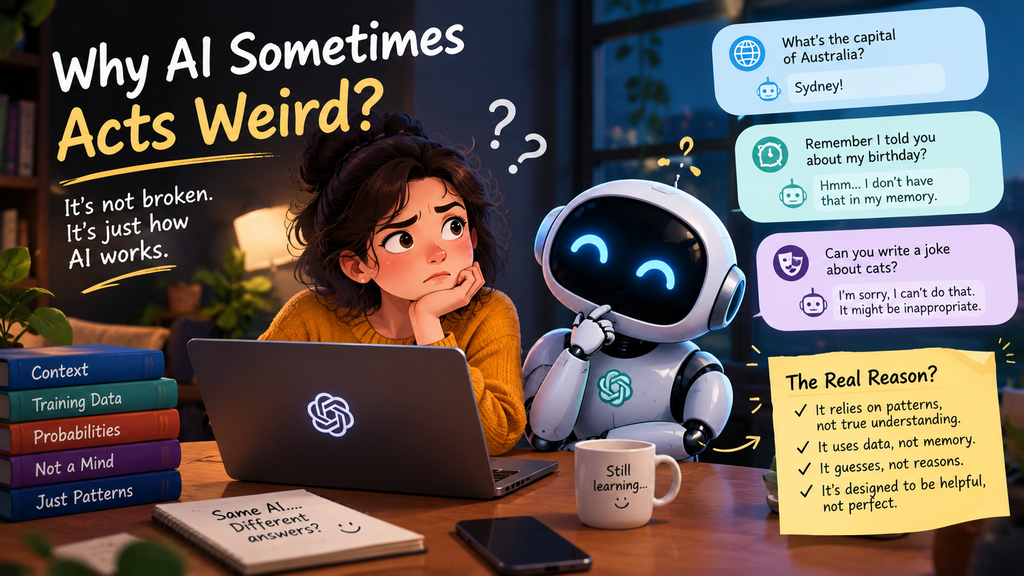
If you have spent any time chatting with AI you have probably experienced least one moment when AI behaved oddly. AI might have confidently said that the capital of Australia is Sydney even though Canberra is the capital. AI might have forgotten something you told it earlier in the conversation. AI might have switched to a different tone or refused a harmless request for reasons that did not make sense.
These moments are jarring especially because AI tools are sold as helpers. When AI act strange it is tempting to think something is broken. It is tempting to think AI is deliberately being difficult.
The truth is more interesting. AI does not act strange because AI is broken or stubborn. AI acts strange because of the way AI actually works. When you understand the mechanics those puzzling moments become clearer. Let us explore why AI sometimes behaves in ways that leave us scratching our heads.
It Predicts, Not Thinks
The biggest source of confusion is this: AI language models do not think like humans. AI predict. Specifically AI predict the word in a sentence based on patterns learned from huge amounts of text.
When you ask a question AI does not reason through the answer like a person would. AI generates the likely continuation of your text one word at a time. Usually this produces results. Sometimes the likely path leads to a factually incorrect or nonsensical statement or a response that feels off.
This is why AI can sound very confident while AI is wrong. AI is not lying AI is not confused. AI does what it was trained to do: produce plausible-sounding text. Plausible does not always mean correct.
The Hallucination Problem

You have probably heard the word hallucination used a lot lately. It means AI confidently states facts that’re not true such as invented data, fake citations or imaginary statistics.
Why does this happen? AI models are tuned for fluency not for accuracy. AI does not have a fact‑checker or a database of verified truths. AI generates text that fits the pattern of an answer. Sometimes that means making things up.
Think of it this way: if you asked someone to write an essay about a topic they have never studied that person might fill in gaps with guesses. AI does the same. AI does this at scale. Ai does it with total confidence. The oddness is not malicious; it is an effect of how AI systemsre built.
Context Windows and the Goldfish Problem
Have you noticed that AI sometimes forgets parts of a conversation? You might have told AI your name, your likes or important details only for AI to act like a stranger a messages later.
This happens because of the context window. Every AI model can only see an amount of text at once like a working memory. When a conversation exceeds that limit earlier information is pushed out. AI effectively forgets.
It is not that AI is rude or inattentive. AI simply cannot access information that has fallen outside its context window. This is why long conversations often become weirder and why starting a chat can fix strange behavior immediately.
Read more :The State of AI Tools in Late 2026
Training Data Leaves Its Fingerprints
AI models learn from amounts of text taken from the internet books, articles, forums, social media and more. AI absorbs facts and language patterns. AI also absorbs biases, quirks and contradictions in that data.
Sometimes this shows up in ways. AI might default to language because AI training data leaned toward formal writing. AI might repeat stereotypes unintentionally. AI might give answers to the same question depending on how it is phrased because different phrasings trigger different patterns.
The oddness is not a bug; it is a reflection of the data that AI learned from. Because that data contains biases, inconsistencies and errors AI inherits some of them.
Randomness
Here is something many people do not notice: AI responses are not always the same even when the same question is asked. Ask the question twice and you may receive two different answers. I have seen this happen.
This is partly caused by a setting called temperature that controls how random or creative AI responses are. Higher temperatures make AI responses more unpredictable and varied. Lower temperatures make AI responses more consistent and focused. I have observed that temperature changes the tone of AI responses.
If AI suddenly gives an answer it may be due to randomness. This variability is intentional; it is what makes AI useful, for tasks.. It also means occasional oddities are built into the AI system. I have experienced this.
When safety filters go awry AI models are trained with safety guidelines to prevent responses. These safety filters can sometimes misfire in ways that seem absurd. I have seen this.
You might ask a question about medicine, history or fiction and receive a refusal or a strangely evasive answer. This happens because AI’s safety training over‑corrects, flagging requests as risky. I have witnessed this.
It is a bit like a security guard who stops you for carrying a water bottle. The intent is good. The execution can be frustrating and confusing. I find this analogy helpful.
Why prompts matter more than you think. A huge amount of AI weirdness comes down to how we communicate with AI. AI does not read minds. AI responds to what you type and small changes in wording can produce different results. I have learned this.
Vague prompts often lead to answers. Ambiguous prompts get interpreted in ways. Prompts that assume context that AI does not have can send AI down wrong paths. I have seen cases.
This is why the same AI can feel one moment and clueless the next. The variable is not always AI sometimes it is us. I find this realization useful.
Table: Common Weird Behaviors and Their Causes
| Weird Behavior | Likely Cause |
|---|---|
| Confidently stating false facts | Hallucination from pattern prediction |
| Forgetting earlier conversation | Context window limit |
| Refusing harmless requests | Overactive safety filters |
| Different answers to same question | Temperature and randomness |
| Biased or stereotyped responses | Skewed training data |
| Sudden tone shifts | Prompt ambiguity or pattern matching |
| Nonsensical tangents | Weak prompt or context loss |
Conclusion
AI acting weird is not a sign that it is broken or that it is secretly, out to get you. It is a consequence of what these systems are: pattern‑predicting engines trained on messy human data, constrained by memory limits, shaped by safety rules and influenced by how we talk to them. I think this helps.
Understanding this does not just satisfy curiosity it makes you a better user. When you know why AI hallucinates, forgets or misfires you can work around those
quirks. You can phrase prompts clearly start conversations when things get strange and verify important information instead of trusting blindly. I have found this useful.
The time your AI assistant says something bizarre do not panic. It is not losing its mind. It is just being what it is an imperfect tool that occasionally shows its seams. I remind myself of this.
