

Introduction
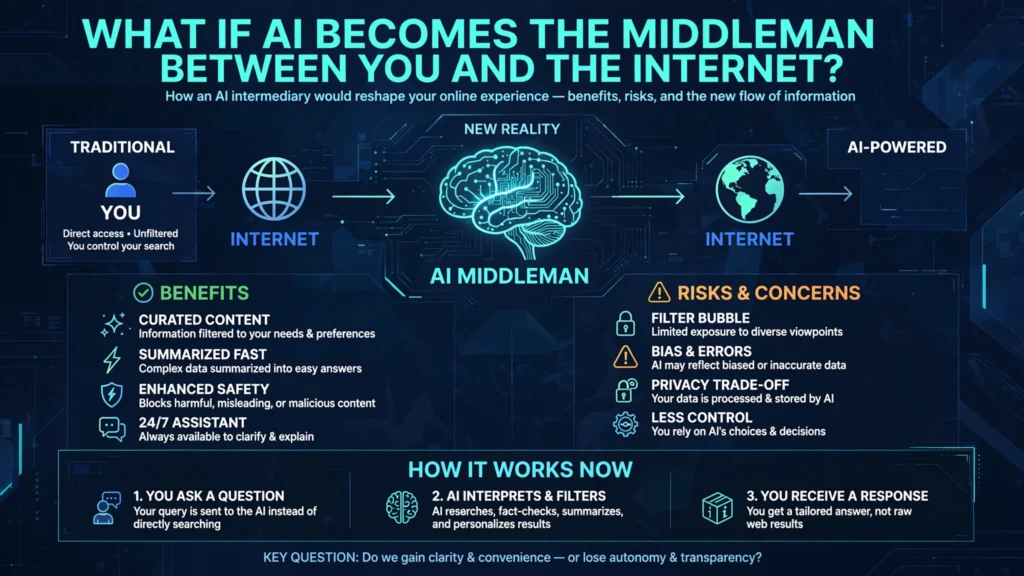
For nearly three decades, the internet has been built around a simple premise, that you type a query, scan a list of links, and click your way to an answer. The browser was a window and you were the pilot. But that era is now ending.
A new layer of intermediation is forming between you and the online world that is not just powered by artificial intelligence, but that uses AI to interpret, summarize, and act upon the information in between. AI agents are becoming the middlemen between you and the internet, fundamentally changing how information is accessed, how value is distributed, and who holds power in the digital economy
This shift is already underway: OpenAI’s ChatGPT Atlas, Perplexity’s Comet, and similar AI-native browsers are collapsing the traditional search-and-browse model into a single conversational flow where, rather than visiting websites, you state an outcome and let the agent deal with the details. As one industry analysis put it, we are moving from “a web of browsing and transactions to a web of discovery, action, and outcomes”
But what does this mean for the open web, for the businesses that depend on it, and for the users who increasingly delegate their digital lives to machines
The Architecture of Intermediation
In order to understand what AI agents change, it helps to understand what came before: the internet has always involved layers of intermediation. Internet Service Providers connected you to the network, Search Engines indexed the web and ranked results, Social Platforms curated what you saw. Each layer introduced unique dynamics of power, value extraction, and control.
AI agents represent something structurally different. According to a 2026 analysis in Future Internet, AI agent intermediation constitutes a “structurally distinct intermediation layer” that introduces new dynamics of power, opacity, and value distribution. Unlike search engines, which at least presented a visible list of options for users to choose from, AI agents can collapse the selection process entirely: they don’t show you ten blue links, but one answer, one recommendation, one action taken.
The researchers identify three cumulative levels of AI intermediation:
Conversational LLM interfaces (chatbots) that generate responses from training data
Answer engines that couple LLMs with live information retrieval (e.g. Perplexity, Google AI Overviews)
Task-executing agents that autonomously perform actions on third-party services on the user’s behalf – booking, purchasing, submitting information
It is this third level that represents the most radical departure: when an AI agent books your restaurant reservation, orders your groceries, or negotiates your insurance renewal, the websites and services involved never interact with a human being who is delegating decision making to an AI
The Collapse of the Click
The first casualty of AI intermediation is the click. For twenty years, the internet economy was based on clicks: pageviews, ad impressions, referral traffic. Publishers created content, search engines indexed it, users clicked through, and advertisers paid for attention.
AI agents don’t click: they read, synthesize, and answer. When you ask an AI assistant a question, it may pull information from dozens of sources, but the sources themselves may not see a visitor. Google’s own AI Overviews, which place AI-generated summaries at the top of search results, have demonstrated the impact: research from Pew found that users encountering an AI Overview clicked through to a source link only 1 percent of the time, compared to 15 percent on a standard results page. SEO firm Ahrefs measured a 34.5 percent drop in click-through rate on the top organic position when an AI Overview was present
The implications for publishers are existential: if AI agents become the primary interface for information retrieval, the traditional publisher revenue model of monetizing search-referred traffic through display advertising collapses
The content still gets consumed, but it gets consumed by an agent that never generates a pageview, never triggers an ad impression, and never delivers a visitor who might subscribe.
This is not a hypothetical future: in late 2025, the digital publisher Salon had a “mid-sized” advertiser shut off its entire ad spend as a direct result of a spike in “agentic visitors” – AI agents visiting the site on behalf of human users, indistinguishable from human traffic in server logs, but generating no ad revenue
Read more:Why AI Sometimes Acts Weird
The Publisher Squeeze: When Agents Look Like Humans
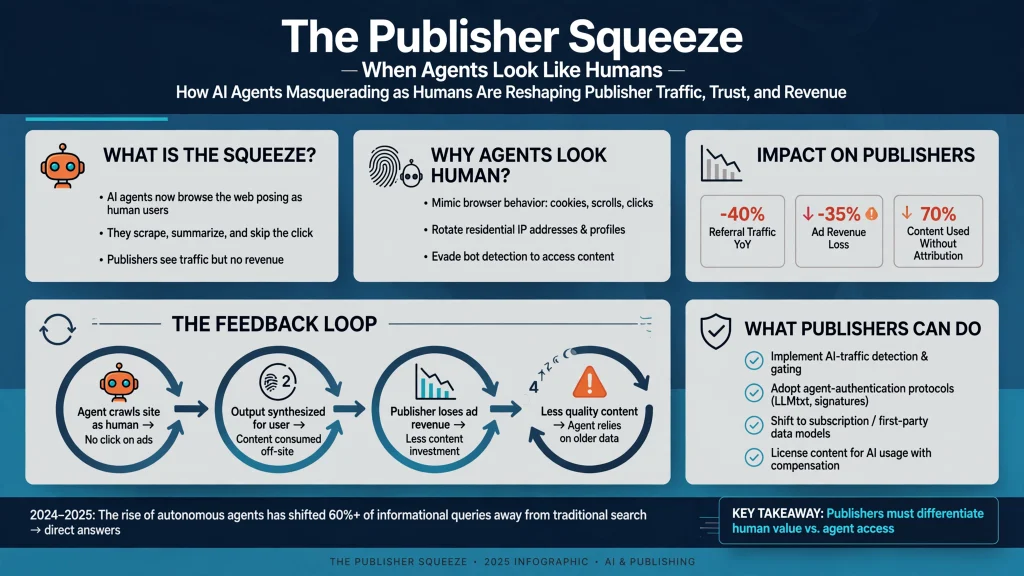
The Salon case demonstrates a deeper problem: AI agents are becoming indistinguishable from humans in website analytics. This poses “a gnarly problem” for publishers, according to Digiday.
The issue is technical: when an AI browser like Atlas or Comet visits a website, it appears in server logs as a standard Chrome connection. The publisher cannot distinguish it from a human who is actually using Chrome. Blocking it could block real users, and allowing it means serving content to an agent that will never see an ad, click a link, or subscribe.
The measurement industry is struggling to adapt: integral ad science and DoubleVerify, the primary invalid traffic detection vendors, currently classify agentic visitors within general invalid traffic parameters – essentially treating them as bots. This triggers advertiser alarms and, in Salon’s case, spending freezes
But agentic visitors are not bots in the traditional sense – they are acting on behalf of a specific human’s request. They are, in a sense, the user’s proxy. Treating them as fraudulent traffic is technically correct but practically disastrous – it penalizes publishers for a shift in user behavior that is completely outside of their control
Olivia Joslin, COO of TollBit (which helps publishers charge AI bots for content access), described the situation bluntly: “Agents and bots mimicking humans is an anti-pattern that has dangerous implications, such as eroding advertiser trust”
The Battle for the Browser
The companies building AI agents understand that the browser is the strategic chokepoint: control the browser and you control the interface between users and the web. Control that interface and you control the flow of information, commerce, and attention
OpenAI’s Atlas, launched in late 2025, is the most aggressive move in this direction: Atlas places ChatGPT at the center of the browsing experience – you don’t navigate to websites, you ask for outcomes. During a demonstration, OpenAI’s team had Atlas compile a dinner shopping list based on a specified dish and guest count, then presumably handle the shopping
Perplexity’s Comet offers a similar proposition where Perplexity’s answer engine is fused with in-page reasoning and action. Microsoft has embedded Copilot into Edge and Google has been retrofitting Chrome with Gemini-powered features, though analysts note Google is constrained by its existing business model – the company makes too much money from traditional search ads to fully cannibalize its own model
The dynamics are telling: “In the long run, the browser is not necessarily where everything happens… we’re shaping behavior; winning where users currently are is going to be critical for that long-term market share that they are all fighting for”, said an analyst
The browser is not the end-game – it is the current battlefield in a war for control of the AI-mediated web
The Attention Economy Rewritten
The advertising industry is built on one premise: attention can be captured, measured, and sold. Advertisers pay for impressions because humans navigating the web are distractable – a banner ad works because it interrupts; a sponsored search result works because it competes for the user’s click
But AI agents don’t get distracted: they don’t click ads, they don’t scroll past sponsored content and then decide to buy something they execute tasks with single-minded efficiency
Andreessen Horowitz’s crypto arm warned in a 2026 analysis that AI agents threaten the $291 billion internet advertising market because the entire “distraction economy” model collapses when the consumer is a machine. “The ad makes money because humans get distracted by banners and pop-ups; LLMs and AI agents do not get distracted,” said Sam Ragsdale of Merit Systems
This creates a paradox: the free, open web was funded by advertising, and the content that was trained the large language models was created because publishers could monetize that content through ads
Now the LLMs are killing the ad model that funded their own training data
“The ad was a clever hack that is now dying,” said Ragsdale
But what replaces it? Some AI platforms are experimenting with sponsored answers/recommendations, while others are building walled-garden commerce systems where transactions happen entirely within the AI interface and the platform takes a cut
Neither model replicates the open, decentralized nature of the ad-funded web
The New Gatekeepers: Power and Opacity
When AI becomes the middleman, the critical question is not just what it does, but why it does it: why did the agent recommend that restaurant? Why did it choose that news source? Why did it suggest that product?
In the current web, the selection process is visible enough to exercise judgment: you see the search results, you can spot the sponsored link, you can choose to ignore it
With AI agents, the process can disappear entirely: the agent presents one answer as if it were obvious and the user has no visibility into the factors that shaped that answer
Mozilla CEO Anthony Enzor-DeMeo put it succinctly: “When you’re going with an agent, an agent is providing you the answer. Is this information that is given to me because the bot thinks it’s the best, or is it because it might be an ad?”
This opacity creates new forms of power the companies that control AI intermediaries control what information reaches users, what businesses get discovered, and what products get purchased
“If AI is now the interface between brands and buyers, then the real question becomes: who actually controls that relationship?” asked one analyst
Amazon has already banned Meta’s AI agent from scouring its website to order goods on behalf of users, apparently fearing that agent-mediated shopping would bypass Amazon’s own retail interface and advertising
The Agentic Visitor: A New Kind of Traffic
For website operators, AI agents create a novel problem: a new category of visitor that is neither human nor traditional bot
These “agentic visitors” are becoming a significant source of traffic for some publishers, but they generate no revenue and are often misclassified as fraudulent traffic (per Digiday’s “gnarly problem”)
DoubleVerify’s data shows that general invalid traffic nearly doubled year-over-year in late 2024 with monthly volumes passing 2 billion ad requests. The company attributes the surge primarily to AI crawlers and scrapers
Publishers are increasingly concerned that their traffic reports are becoming polluted by non-human visitors who aren’t there to see ads but to extract information
The situation is most acute for publishers with paywalls: AI browsers like Atlas and Comet can reportedly access paywalled content on behalf of users, bypassing the subscription mechanisms that publishers use to get revenue
Because these browsers appear as normal Chrome connections, blocking them could block legitimate users
“Traditional defenses like paywalls and crawler blocking mechanisms are no longer sufficient to prevent AI systems from accessing and reproducing news content without consent,” said one industry report
What Comes Next: A Web for Agents
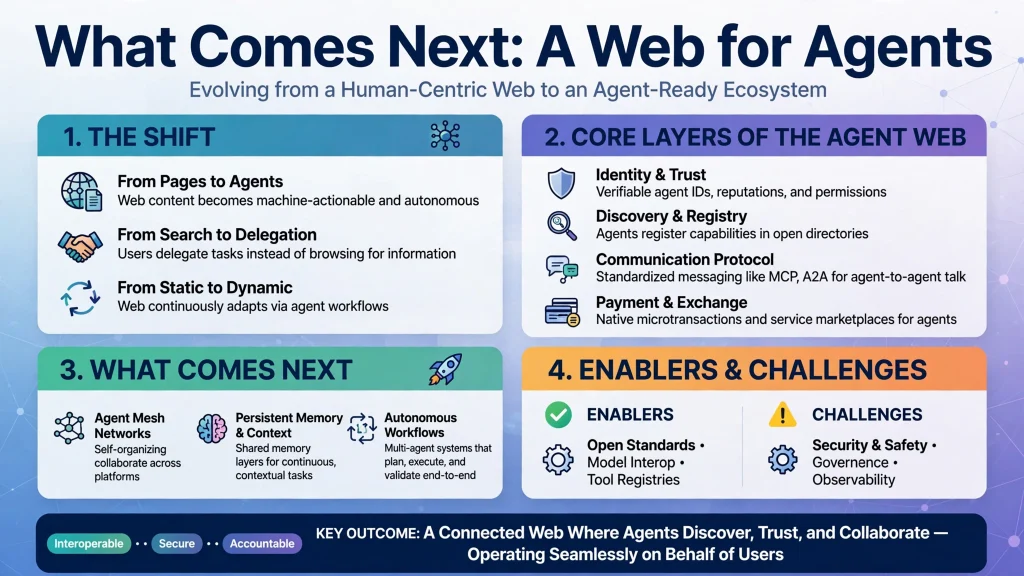
The web was built for humans clicking links. The emerging web is being built for agents that are completing tasks. Changes in design, content structure, and value exchange are needed to accommodate the new reality
The emerging discipline of “AI Experience Optimization” reflects this reality: “Classic SEO was written for crawlers and clicks. The next play is AEO: AI Experience Optimization. Design your content and commerce so agents can understand, trust, and transact,” said one analysis
This means making data callable through APIs, and data machine-readable through structure, and creating surfaces where agents can complete tasks without human intervention
Websites that can’t be parsed, reasoned over, and acted upon by agents risk being sidelined entirely
The implications extend beyond commerce: if agents privilege content with clear provenance, recency, and structure, the web could bifurcate into two tiers agent-optimized content that is efficient but bland, and human-oriented content that is richer but not visible to the AI intermediaries that are increasingly mediating discovery
The Regulatory Reckoning
The rise of AI intermediation is prompting calls for regulation, though the shape of that regulation is contested. The EU has taken a precautionary approach, while the US is focused on ex-post enforcement
China’s approach, as articulated at the 2026 World AI Conference, emphasizes standards development and “trusted agent” certification
The governance challenges are substantial – AI agents raise questions of identity (“how do you know an agent is acting for whom it claims?”), accountability (who is responsible when an agent makes a harmful decision?), and competition (do AI intermediaries entrench market power in new ways?)
China’s Academy of Information and Communications Technology has proposed that agent identity should include three elements: identifier, credential, description. The organization is working on standards for agent registration, addressing, and interconnection protocols
These are the plumbing issues that will determine whether the agentic web is open and interoperable or fragmented into competing walled gardens
Conclusion
The question posed at the outset – what if AI became the middleman between you and the internet – has an answer that is both promising and unsettling
The promise is genuine: AI agents could make the web dramatically more useful, screening out noise and handling tedious tasks
For people who struggle with the complexity of the modern web, agents could be a liberation
But the risks are also real: an AI-mediated web could be smaller, more controlled, and less transparent
It could concentrate power in the hands of a few companies that control the dominant agents, and it could deny the open web the revenue that funds independent content creation
The middleman is here, but what kind of middleman it becomes is still being decided
