

Introduction

The landscape of education is undergoing a transformation. What was once an endeavor a student hunched over textbooks late into the night struggling to decode complex concepts alone is rapidly evolving into a collaborative experience between human learners and artificial intelligence. The narrative surrounding AI in education has often been polarized: one camp predicts the demise of thinking while another heralds a utopian revolution in learning efficiency. The reality as emerging research demonstrates is more nuanced and for students willing to engage thoughtfully remarkably promising.
The scale of adoption is unprecedented. A 2026 report from HEPI finds that 95% of students now use AI in at least one way for their studies and 94% use it to help with assessed work. Eurostat data cited by the European Commission shows that four in ten young people aged 16 to 24 in the EU used AI tools for formal education in 2025. This is not a fringe phenomenon; it is the normal of academic life.
The mere availability of AI tools does not guarantee improved learning. The critical insight emerging from research is that how students use AI matters far more than whether they use it. As the European Commissions report aptly titled “Friend or foe?” concludes, students are more likely to benefit when AI supports their own thinking and they actively engage with the content. The difference between AI as a crutch and AI as a scaffold lies in the habits and strategies students bring to the interaction.
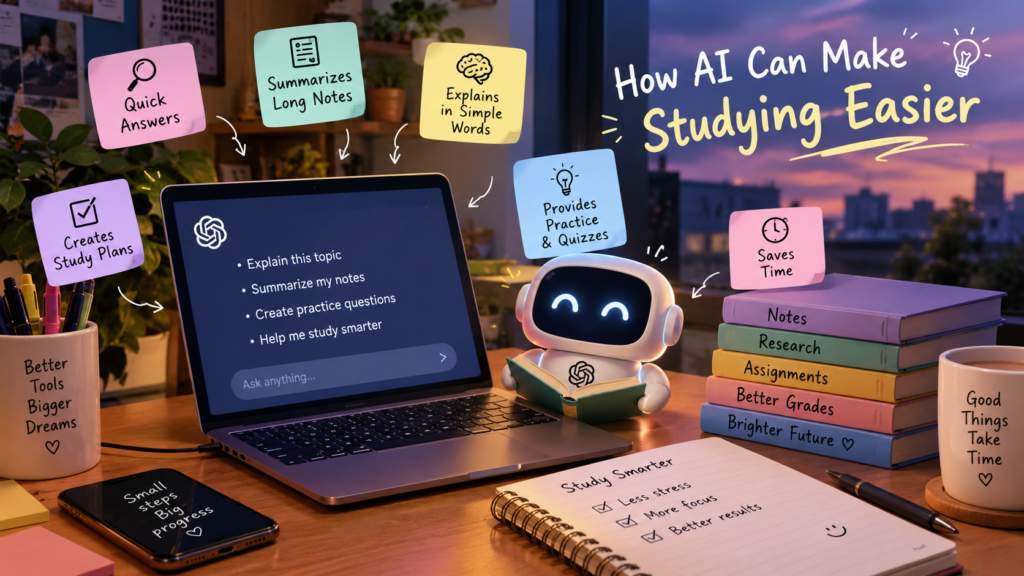
This article provides an exploration of how AI can genuinely make studying easier—not by doing the work for students but by removing unnecessary friction personalizing learning experiences and supporting the cognitive processes that lead to durable understanding. Drawing on research institutional case studies and the evolving ecosystem of educational AI tools we will examine the specific mechanisms through which AI can transform the study experience the evidence supporting these approaches and the essential caveats that every learner should understand.
Understanding the AI Revolution in Education
The Shift from Generic Tools to AI
The first wave of AI in education was characterized by students repurposing general-purpose tools like ChatGPT for academic tasks. While this demonstrated the technologys potential it also revealed limitations. General-purpose AI, trained on unvetted datasets could produce plausible-sounding but inaccurate information a phenomenon known as hallucination that posed particular risks in academic contexts where accuracy is paramount.
The current moment represents a maturation of the field. Purpose-built educational AI tools are emerging that address the needs of learners and educators. Elseviers ClinicalKey Student for instance has added StudyFinder AI specifically to connect medical students to trusted, content. As Brent Gordon, President of Elsevier Healthcare Education explains: “Most AI tools available to students today lack answers supported by verifiable sources. ClinicalKey Student is different every StudyFinder AI response is drawn from content that medical schools recommend including Elseviers evidence-based content. Is instantly verifiable”. This emphasis on trusted sourcing represents an evolution acknowledging that for learning to be effective the information on which it is based must be accurate and authoritative.
This shift from generic to AI is significant. Research from the European Commission indicates that educational AI tools generally produce learning outcomes than general-purpose tools. The reason is straightforward: educational AI is designed with principles in mind. It understands the importance of scaffolding of breaking concepts into manageable components of providing feedback that guides rather than merely answers.
The Spectrum of AI Study Applications
AIs role in making studying spans a remarkable spectrum of applications from the immediately practical to the deeply cognitive. At one end are tools that handle burdens organizing files summarizing readings generating practice questions. At the end are systems designed to foster metacognition, Socratic dialogue and the kind of deep processing that leads to genuine understanding.
The contemporary AI ecosystem for students includes:
agents like ChatGPT, Gemini and Copilot that can explain concepts answer questions and serve as thinking partners across disciplines.
Purpose-built study platforms like Turings GPAI, which manages lecture materials generates predicted exam questions. Creates presentation slides streamlining the entire academic workflow.
Integrated learning environments like Googles Gemini Notebook ( NotebookLM) which allows students to upload their own materials lecture recordings, notes, course PDFs and engage in voice conversations anchored strictly to those sources.
Specialized subject tools like Elseviers StudyFinder AI for education which grounds every response in verified textbooks and clinical guidelines.
Browser-integrated features like Chromes quiz generation from tabs enabling students to test comprehension directly from their research materials.
This diversity of tools reflects the recognition that studying’s not a monolithic activity. Preparing for a medical board exam requires support than writing a history essay, which in turn differs from debugging a programming assignment. The effective AI-enhanced study strategies involve selecting the right tool for the specific cognitive demand at hand.
AI as a Personalized Tutor
Adaptive Explanations and the “Explain Like I’m Five” Paradigm
One of the immediately accessible and powerful applications of AI for studying is its capacity to provide explanations tailored to the learners current level of understanding. Traditional instruction, constrained by the realities of classroom management must often adopt a one-size-fits-all approach. A teacher explaining photosynthesis to thirty students cannot simultaneously provide the overview needed by one student the biochemical detail required by another and the evolutionary context that would engage a third.
AI dissolves this constraint. A student who encounters a concept in a textbook can paste the passage into an AI assistant and request a simpler explanation. If that explanation still doesn’t land they can ask for it to be rephrased, analogized or broken down further. This iterative clarification process, which might otherwise require trips to a professors office hours or the fortuitous availability of a patient study partner can now happen in real-time at any hour in any location.
Research from the University of Phoenix involving 491 traditional undergraduate students found that the most prominent use of AI among those surveyed was “improving understanding and clarifying complex concepts”. This finding challenges the assumption that students primarily use AI to avoid work. Instead it suggests that AI is being deployed as a comprehension aid a tool for making difficult material accessible.
The educational principle at work here is the zone of development a concept from developmental psychology that describes the space between what a learner can do independently and what they can achieve with guidance. Effective tutoring targets this zone providing enough support to enable understanding without eliminating the productive struggle that leads to learning. AI used well can function as a tutor operating precisely in this zone calibrating explanations until the learner achieves comprehension.
Read more :The Growth Of Ai Tools
Socratic Dialogue at Scale
Beyond explanation AI can engage students in the kind of questioning dialogue that promotes deeper processing. Georgia Techs Socratic Mind project exemplifies this potential. Piloted with than 700 students in online and in-person courses Socratic Mind uses AI to prompt students to explain their reasoning apply their knowledge and identify gaps in understanding.
The pedagogical philosophy underlying this approach is significant. Than simply providing answers Socratic dialogue forces learners to articulate their thinking making their cognitive processes visible to themselves and their instructors. As Lesley Baradel, a School of Biological Sciences lecturer at Georgia Tech observed: “One of the things that interested me most was the opportunity to extend academic conversations beyond the time and space available in a classroom. Using Socratic Mind in my classroom showed me how AI can facilitate reflection and discussion at a scale to achieve through one-on-one interactions alone”.
The scalability dimension is crucial. A single instructor cannot engage in Socratic dialogue with every student in a large lecture course.. An AI system can. This doesn’t replace the value of interaction it extends the reach of pedagogically valuable dialogue to contexts where it would otherwise be impossible. Results from the Socratic Mind pilot indicated that AI could promote engagement when it challenges students to think through and revise their ideas rather than simply providing answers.
For students studying independently this model suggests a strategy: rather than asking AI for answers ask it to quiz you to challenge your reasoning to play devils advocate. The AI becomes not an answer machine but a thinking partner, one whose purpose’s to make you think more deeply not to think in your place.
Multimodal Learning Support
Contemporary AI is increasingly multimodal, capable of processing and generating text, images, audio and video. This opens avenues for making abstract concepts concrete. Googles Gemini for instance can generate 3D simulations a student writing a paper on DNA can enter a prompt and be presented with a rotatable zoomable model that makes the structure tangible.
Chromes Gemini integration now allows students to analyze video content beyond YouTube, including podcasts, lecture recordings and videos on other websites. After content has been played Gemini can find information highlight key points and explain sections that may be difficult to understand. This transforms listening into an interactive learning experience.
For language learners and those studying systems from organic chemistry to constitutional law multimodal AI represents a significant enhancement. The ability to see a concept hear it explained and interact with it in representational formats aligns with research, on dual coding and multimedia learning, which suggests that information encoded in both verbal and visual formats is more deeply processed and better retained.
AI-Powered Study Tools and Platforms
Intelligent Content Organization
The overhead of studying organizing notes, managing files tracking sources consumes time and cognitive resources that could be devoted to actual learning. AI is increasingly capable of handling this burden allowing students to focus on comprehension and retention.
Turings GPAI platform shows this trend. Its AI Drive feature helps users manage lecture materials, notes and assignment files in one place reducing the need to re-attach the files or re-explain content each time a task is switched. The system is built around the reality that academic work involves moving between different materials, courses and task types.
Googles Gemini Notebook (formerly NotebookLM) uses a method acting as a “container” for all learning traces. Students can record class lectures take photos of notes upload course PDFs and then work with all of these materials through a single interface. The recent addition of voice conversation through Gemini Live allows students to “speak” with their notes asking questions and getting answers based on their uploaded materials. This solves an issue with general-purpose AI: the chance of getting information that while possible is not connected to the specific course content the student is supposed to learn.
Automated Summarization and Note-Taking
The use of AI for summarization and explanation is the common behavior among students using these tools. This is not surprising the amount of reading required in courses is large and the ability to create a short summary of a difficult passage can help students find the main arguments and decide where to focus their attention.
However the educational value of summarization depends entirely on how it’s used. A student who copies an assigned reading into an AI gets a summary. Then never looks at the original text has learned very little. A student who reads the passage themselves makes a summary. Then compares the two to find what they missed has done a strong metacognitive exercise.
The research from the University of Phoenix found that students describe GenAI as a “thinking partner” or learning aid for brainstorming and organizing ideas and as a tool for improving efficiency and productivity. The term “thinking partner” is important. It suggests a relationship where the human’s the main cognitive agent, with AI providing support that improves rather than replaces their own thinking.
Flashcard Generation and Spaced Repetition
Chromes new quiz generation feature lets students create quizzes from content in open tabs, including Google Docs, research papers and lecture videos. The system finds concepts and creates questions that let students test their understanding. Googles study hub in Gemini offers flashcards and practice quizzes.
This automation of test creation solves an obstacle to effective studying. Research on learning science shows that retrieval practice actively trying to remember information than just looking at it leads to stronger and longer-lasting learning than rereading or highlighting. Spaced repetition, which involves reviewing material at increasing intervals makes this even better.
The problem has always been the effort needed to make flashcards and practice questions. AI reduces this effort a lot. A student can upload lecture notes, textbook chapters or research articles. Get a set of questions about key concepts. Chromes feature for example works with content in tabs meaning a student researching a topic can test their understanding without leaving the browser.
The warning as always is that the quality of AI-generated questions can vary. Students should check the questions for accuracy. Whether they fit the course goals.. Even this checking process—looking at questions finding gaps improving them counts as active involvement with the material that helps learning.
AI for Writing and Research Support
From Blank Page to Structured Draft
For students the hardest part of academic work is the blank page. Starting a research paper creating a thesis organizing arguments these tasks need synthesis and judgment that can feel overwhelming especially when the stakes are high and the material is unknown.
AI can help bridge the gap between having sources and having a draft. As one study on information seeking found AI-anchored conversational agents like AskAda help users find topics and get resources supporting new users in structured academic exploration. Turings GPAI platform gives an outline before making presentation slides allowing users to check and change the structure before content is created. This step reflects a design approach: the AI suggests, but the human decides, checking and guiding at each step.
For writing the best use of AI is not to write the final text but to help with planning and revising. A student might use AI to brainstorm arguments to get counterarguments they hadn’t thought of to suggest how to organize evidence or to get feedback on a draft. These uses keep the student as the writer while using AIs ability to create alternatives and find patterns.
The University of Phoenix research found that students were worried about the accuracy and originality of AI-generated content and the loss of their academic voice. This concern is good it shows that students are not blindly accepting AI output but are thinking about it which’s the attitude that should be encouraged.
Literature Review and Source Discovery
The research process finding sources checking their trustworthiness combining their arguments is one of the most time-consuming parts of academic work. AI is becoming better at helping with this in ways that support than replace scholarly judgment.
The AskAda project tested an AI-anchored agent for scholarly information seeking with tasks from simple known-item searches to complex conceptual searches requiring synthesis of knowledge. The system showed strengths in reliability, clarity and speed helping people with AI experience to engage confidently with academic content. The developers said future work will focus on adding authoritative databases and adaptive feedback to better understand complex topics.
This mixing of AI with databases is important. StudyFinder AI in Elseviers ClinicalKey Student uses a collection of evidence-based textbooks over 6,000 multiple-choice questions and over 1,000 short videos. Every answer includes citations letting students check sources and follow the trail to literature. For students, who need to make evidence-based decisions this openness is not just helpful it is essential to their professional training.
Feedback and Revision Support
One of the helpful uses of AI for writing is giving formative feedback on drafts. Unlike feedback which checks completed work formative feedback guides the student to improve while writing. The challenge is that giving formative feedback on drafts is hard and instructors with big classes may not be able to do it as often or as well as students need.
AI can help here. Students can share drafts with an AI assistant. Ask for feedback on clarity organization, argumentation or grammar. The AI can find parts suggest other ways to say things point out logical gaps or catch inconsistencies. The student is still in charge of deciding what to use. Getting immediate specific feedback removes a big barrier to revising.
Research on AI literacy shows that AI feedback is useful when students know how to question it judge it and use it. The output alone doesn’t teach; the students reaction to the output is where learning starts. This shows the importance of building thinking skills along with AI use. A student who takes AI feedback without thinking may add errors. Lose their writing style. A student who looks at feedback carefully checking if suggestions match their goals trying alternatives and keeping their voice uses AI as a revision tool.
AI for Exam Preparation and Assessment
Predicted Question Generation
Turings GPAI platform has a question generation feature that lets users upload past exam questions or textbook examples and get predicted questions of the type and difficulty. This method understands a truth about exam prep: the best way to get ready for answering questions is to answer questions.. Students often run out of practice materials or they don’t have access to relevant questions for their specific courses.
AI-generated predicted questions can help here giving practice opportunities that match the actual exam. The system lets users choose the question type and difficulty level making practice that fits their ability and changes as they get better.
The educational value goes beyond practice. By making questions like the exam AI helps students build test-taking skills, time management and familiarity with question formats. This reduces test anxiety. Improves performance but more importantly the act of answering predicted questions is itself a form of retrieval practice one of the most effective learning methods found by cognitive science.
Adaptive Practice and Spaced Repetition
Chromes quiz generation feature and Googles study hub both let students test their understanding anytime. The advanced educational AI systems go further changing the difficulty and focus of practice based on student performance. This is the idea of learning: giving practice that is just hard enough to challenge the student without overwhelming them.
The OECDs Digital Education Outlook 2026 says that generative AI can offer learning through smart tutoring systems, adaptive feedback and group learning environments. These tools provide tailored explanations and help possibly giving access to the kind of support that was only possible with expensive tutoring or lucky personal situations.
For students preparing for exams medical boards, professional certifications, grad school admissions—adaptive AI practice gives a way to study more effectively. Of looking at material they already know students can focus on areas they need to improve using AI to find gaps and give targeted practice to fill them.
Real-Time Formative Assessment
The PLICKERS and Magic School Chatbot integration in an example shows how AI can support real-time formative assessment in the classroom. PLICKERS lets teachers check understanding with polls while the AI chatbot gives personalized revision support. This mix changes assessment from a teacher-controlled process, into an interactive and ongoing learning experience.
For students who are studying on their own the main thing is the ability to get feedback on how well they understand something. Of studying for a long time and not knowing if they are on the right track students can talk with AI test their ideas and get corrections right away. This quick feedback helps them learn faster by stopping them from getting the wrong ideas stuck in their heads.
Research about using AI to help with studying shows good results. These include interest and motivation when students are taking tests or reviewing more confidence and independence and faster ways to find out what they don’t know. Finding out what they don’t know is very important. Students often don’t realize what they don’t know. This is called the illusion of fluency, where they think they understand something because it seems familiar. They really don’t. AI can help by asking questions that the student can’t answer, giving them an idea of how much they know.
AI for Learning Skills and Practicing
Language Learning and Improving Communication
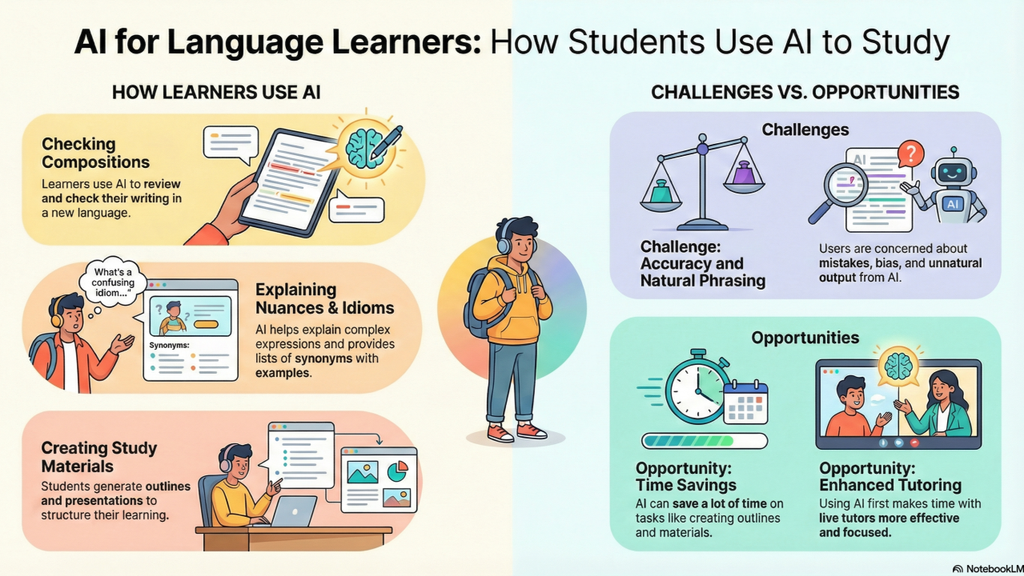
AIs ability to work with types of information makes it especially useful for learning languages and improving how people communicate. A project at Georgia Tech called AI-Supported Healthcare Communication Training used AI to create situations give feedback on how someone speaks and help with vocabulary for people who work in healthcare and need to talk well in serious situations.
Karen Peterson, who is a teacher working on the project explained how it worked. She said, “I used AI to find the vocabulary for healthcare make learning materials create realistic situations and make activities that fit what the students needed to learn.” The focus on helping with areas shows the personalization that AI can provide. Of practicing words that the student already knows or situations that are too easy AI can find the exact skills and knowledge that the student needs to get better at.
Peterson gave a message for anyone using AI in learning. She said, “One of the important things from this work is that AI should be used to help with a specific learning goal, not just because the technology is available. When used on purpose AI can help create personal chances to practice and get feedback while helping with the learning goals that matter most.”
For people learning a language AI gives them a chance to practice speaking and writing without feeling nervous about talking to speakers or other students. The AI is patient always available. Can give quick feedback on grammar, words and how someone speaks. It can also act out conversations at levels of formality and in different situations getting learners ready for real-life talks.
Learning to Code and Technical Skills
In computer science classes the use of AI has been going fast. The result of a coding task is a working program and a working program made with AI help is often the same as one made without it. Teachers have started to change what they look at focusing more on checking the code explaining how the code works and having students do tasks in class with a teacher watching.
Students who get the most from AI in programming classes use it like an autocomplete. They write the version themselves get other options compare what the AI made with what they wrote and take the better parts. This way they use AI as a partner in making code not as a way to avoid learning.
The students who have trouble are the ones who start using the tool right away describing the problem and asking for the full solution. These students often do well on assignments. Not so well on exams, where the tool isn’t available. The difference between how they do on assignments and exams has become a sign for teachers.
For students learning to code the message is clear: AI can help them learn faster if they use it actively writing code looking at ways to do it and fixing mistakes but it can stop them from learning if they use it passively. The goal isn’t to make working code but to become the kind of programmer who can make working code. These are not the thing.
Design Skills
AIs ability to create things also works for creative areas. AI tools that make images help with speaking exercises, discussions about cultures and learning grammar. AI can make text versions create stories that match what students like and change real materials to fit the right level of learning.
For students in fields like design, writing and music AI can be a partner in coming up with ideas making options that the person then checks, picks and improves. The creative process usually has steps making a lot of options and choosing the best one. AI can speed up the part where ideas are made giving time for the part where the best ideas are picked and improved.
The problem is that AI-made work might not have the originality and personal touch that makes work special. Students from the University of Phoenix said this saying it’s important to keep their own voice in their work. The answer is not to avoid AI. To use it in a way that helps not replaces, human creativity using it to try new things get past blocks and keep working on ideas while still making the choices about what to create.
The Science of Learning with AI

Cognitive Offloading vs Cognitive Limiting
One worry about using AI in school is the danger of limiting thinking where students rely so much on AI that they don’t build the thinking skills that school is supposed to teach. This worry isn’t silly. One education leader said, “What I’m worried about is that young people aren’t getting hard thinking and deep learning experiences learning is tough it takes effort and trying enough of those to actually build those skills in the first place to later rely on AI.”
The difference between using AI to help with thinking and using it in a way that stops thinking is small but important. People have always used tools to help with thinking like calculators for math maps for directions and search engines for information. The key is that people learned the basics before they used these tools. A student who knows multiplication can use a calculator without losing the ability to multiply. A student who never learned multiplication and just used a calculator from the start never gets that ability.
When it comes to using AI for studying the rule is clear: students should work enough with the material to understand the basics before they use AI for thinking tasks. Using AI to summarize a book is helpful if the student has read it enough to check the summary. Using AI to write an essay is bad if the student hasn’t learned to write their thoughts.
The research shows that students know this difference. In a study at the University of Phoenix students described AI as a helper, not a replacement for their thinking and schoolwork. Open answers showed that students read and understand what AI gives check and compare with sources and then use their own thinking to make it better.
Why It Matters to Be Active
The research keeps showing one thing: AI helps learning when it helps students think more. It hurts learning when it makes them just take in information. A report from the European Commission said, “Students are more likely to benefit when AI helps them think and they are involved with the material.” The OECDs Digital Education Outlook warns that “relying much on AI to get answers might stop deeper learning and make it harder to remember things when students depend too much on automatic help.”
What does it look like to be involved when using AI? It means using AI to check if you understand, not to avoid understanding. It means asking AI to test you to ask why your answer is wrong. It means looking at AI summaries and seeing what you missed. It means using AI as a partner in learning not as a place to get answers.
The research about being able to use AI well calls this “repair ability” the skill to see when AI gives an answer to ask again to add more to challenge the tool and make better answers. Students who get this skill are less likely to accept weak answers. They use AI as a tool they can use well not as something that tells them what to do.
Thinking About Your Thinking
The way to use AI when studying is to help with thinking about your thinking and learning on your own. The OECD says AI can help with learning by using teaching systems and helpful feedback. When done right these systems don’t just give answers they help students learn how to plan check and evaluate their learning.
A 2026 study about tools and learning on your own says that good AI systems can help with planning, checking and evaluating learning but only if those steps are built into the way the system works. This means students should look for and use AI tools that make them think not just give them information. Asking “Can you test me?” or “Can you check my thinking?” changes AI from a tool that gives answers into a partner that helps with thinking.
For example a student getting ready for a test might use AI not to make questions but to help plan a schedule check how they’re doing and decide which topics need more work. AI becomes a coach helping the student get the skills they need for learning on their own. A study from the University of Phoenix found that students who were more comfortable with technology and did better in school used AI more. While this doesn’t prove that using AI makes them better it suggests that using AI is connected with the skills and habits that make learners without AI replacing them.
How to Use AI Well
Choosing the Right Tool for Each Task
There are many AI tools that it can be confusing. Students have many choices each with different ways to help. Using AI well for studying starts with knowing which tool works best for each job.
For understanding topics: General AI that can talk (like ChatGPT, Gemini, Copilot) is good at explaining things in a way that fits the students level. The chance to ask again for explanations examples or stories makes these tools great, for working through confusing ideas.
For organizing and managing course materials: Purpose-built platforms like Turings GPAI or Googles Gemini Notebook offer features specifically designed for workflows, including file management, material integration and source-grounded responses.
For exam preparation: Tools that generate practice questions from course materials or past exams like Turings question generation feature Chromes quiz generation or Elseviers StudyFinder AI for students provide targeted retrieval practice.
For research and writing: AI-anchored scholarly search tools like AskAda and integrated writing assistants can help with literature review, source discovery and feedback on drafts.
For language and communication practice: Multimodal AI with voice capabilities enables practice, pronunciation feedback and scenario-based learning.
The key is to match the tool to the demand. Using a general-purpose chatbot for medical board preparation, where accuracy’s paramount is less appropriate than using a curriculum-aligned tool with verified sources. Using a research platform for a simple vocabulary quiz is overkill.
The Art of Prompting
The quality of AI output depends heavily on the quality of input. Prompting—the craft of formulating requests to AI is increasingly recognized as a component of AI literacy. A vague prompt produces a response; a well-specified prompt produces a focused useful response.
Effective prompting for studying involves principles:
Provide context. Of asking “Explain photosynthesis ” provide context: “I’m a first-year biology student preparing for an exam on plant physiology. Explain the dependent reactions of photosynthesis at a level appropriate for my course highlighting the key steps and common misconceptions.”
Specify the desired format. Do you want a summary, a list, a comparison table, a dialogue, a set of practice questions? Being explicit helps AI deliver what you need.
Set constraints. Specify length reading level focus areas and what to exclude. Constraints focus the AIs attention. Prevent tangential responses.
Iterate. The first response is rarely the best. Ask follow-up questions, request clarification, challenge inaccuracies ask for explanations.
Request. Verification. When accuracy matters ask the AI to cite sources and verify information. Be aware that general-purpose AI may fabricate citations, so verification against sources remains essential.
The research on AI literacy emphasizes that prompting is not merely an interface technique but a skill to be developed. Students who learn to prompt effectively get value from AI tools just as students who learn to ask good questions get more from office hours.
Integrating AI into Study Routines
The effective AI-enhanced studying integrates AI into existing routines rather than treating it as a separate activity. Several patterns emerge from research and practice:
The explain-check-apply cycle: When encountering a concept use AI to get an explanation. Then check the explanation against course materials. Then apply the concept by solving a problem writing a summary or explaining it to someone or to the AI). The AI is one step in a cycle, not the process.
The quiz-review-focus cycle: Use AI to generate practice questions. Answer them without looking at notes. Review your performance to identify gaps. Focus study time on the gaps. This cycle leverages retrieval practice and targeted review two of the effective learning strategies.
The draft-feedback-revise cycle: For writing assignments write a draft yourself. Use AI to get feedback on clarity organization or argumentation. Evaluate the feedback critically. Revise based on what you judge to be valid. The AI supports revision without replacing authorship.
The plan-monitor-evaluate cycle: Use AI to help plan study sessions monitor progress. Evaluate understanding. Ask the AI to quiz you on material you studied week to check whether you remember key concepts from a previous chapter to help you identify what you need to review. This integrates AI into the processes that characterize self-regulated learning.
Maintaining Academic Integrity
The question of integrity in the age of AI is complex and evolving. Different institutions, instructors and courses have policies and students are responsible for understanding and following the policies that apply to them. However some general principles can guide AI use:
Transparency:
If a course requires disclosure of AI use disclose it. If the policy is unclear ask the instructor. The University of Phoenix research found that students expressed uncertainty about use under academic integrity policies suggesting that clearer guidance is needed from institutions and that students should seek clarification when unsure.
AI as support not substitute:
The defensible uses of AI are those that support your own thinking and work rather than replacing it. Using AI to explain a concept generate practice questions or provide feedback on a draft keeps you in the role of learner and author. Using AI to generate content that you present as your own work crosses a line in academic contexts.
Preserve your voice:
Students in the University of Phoenix study expressed concern about preserving their academic voice. AI-generated prose often has patterns that may not reflect your own style. When using AI for editing or feedback ensure that the final work reflects your thinking and your voice.
Verify everything:
General-purpose AI can produce fabricated information. Before relying on AI-generated content for work verify it against authoritative sources. This is not an integrity issue it is a learning opportunity. The process of verification deepens understanding. Develops critical evaluation skills.
Limitations
Accuracy and Hallucination
The fundamental limitation of current AI systems is their potential for inaccuracy. Large language models generate text based on patterns in their training data; they do not have knowledge of truth. They can produce confident-sounding statements that are factually wrong a phenomenon known as hallucination.
The European Commissions report raises concerns about over-reliance on AI affecting thinking skills. When students accept AI-generated information without verification they risk internalizing errors and developing misconceptions that are difficult to correct.
The solution is not to avoid AI but to use it critically. Educational AI tools with sources like Elseviers StudyFinder AI, which draws from evidence-based textbooks and clinical guidelines reduce this risk.. Even with these tools students should maintain a skeptical disposition verifying important claims against authoritative sources.
Equity and Access
Access to AI tools is not evenly distributed. The Eurydice report on education in Europe found that students from disadvantaged socioeconomic backgrounds may have fewer opportunities to develop digital skills and can face difficulties learning at home because of limited access to devices or reliable internet.
This equity concern extends to AI specifically. Advanced AI features often require paid subscriptions. Google offers a year of Google AI Pro to college students in the US but such offers are limited by geography and eligibility. The capable AI tools may be available only to those who can afford them.
Awareness of these disparities is important for both students and institutions. Students who have access should use it wisely; institutions should work to ensure that AI-enhanced learning benefits are available broadly not to the privileged.
The Risk of Superficial Learning
AI makes it easy to produce the appearance of learning without the substance. A student can generate a summary create flashcards and answer practice questions without engaging deeply with the material. This is the risk of what one source calls “AI’ing their way through” education.
The research on AI in learning is clear: AI can improve performance but this does not necessarily mean better learning. A student who uses AI to complete assignments may earn grades while learning little. The long-term consequences for knowledge retention, skill development and professional competence may only become apparent later.
Avoiding learning requires intentionality. Students must ensure that AI use is characterized by the ” thinking” and “deep-learning experiences” that build genuine understanding. The goal is not to complete tasks but to learn deeply. AI should serve the latter not replace it.
Over-Reliance and Dependency
Related to learning is the risk of dependency. If students always turn to AI for explanations always use it to generate questions always rely on it for feedback they may fail to develop the capacity to do these things independently.
The research on offloading provides a framework for thinking about this risk. Offloading is beneficial when the underlying skill has been developed; harmful when it has not. A student who can read and comprehend difficult texts may benefit from AI summarization as a time-saving measure. A student who has never developed reading comprehension skills may be harmed by relying on AI to tell them what texts mean.
The solution is to use AI as a scaffold that is gradually removed, not a support. As skills develop students should test themselves without AI assistance ensuring that they can perform independently. The Socratic Mind projects emphasis on prompting students to explain their reasoning reflects this principle the goal is to develop thinking capabilities that persist beyond the AI interaction.
Future Directions
Toward Intelligent and Adaptive Systems
The trajectory of AI in education points toward systems that are increasingly personalized, adaptive and integrated into learning workflows. Future systems may better understand individual student needs their knowledge state, their learning goals, their preferred modes of engagement and tailor support accordingly.
The research on LLM-supported learning emphasizes the concept of scaffolding providing support that is calibrated to the learners ability and gradually faded as competence develops. Systems that make strategies explicit, calibrate assistance and transfer responsibility to learners may better support competence than systems that simply provide answers.
For students this suggests a future in which AI becomes less of a tool and more of an integrated learning environment one that knows their strengths and weaknesses that anticipates where they will struggle that provides support that is responsive to their moment-, to-moment needs.
Integration Across Learning Ecosystems
The current situation is broken up. Students use one tool for taking notes another for practice questions and a third for getting feedback on writing. Future systems could bring these together creating a learning experience.
Google is expanding learning tools across Search, Gemini and Notebook. This is one idea for how everything can come. The aim is to change how AI is used for learning from “one-time question” to ” conversation ” covering the whole process from basic understanding to deep learning.
Turings GPAI platform also wants to manage the academic process organizing materials preparing for tests doing assignments making presentations all in one place. Developing features that connect university lecture websites with AI Drive would make things easier letting students get materials directly without having to download and upload again.
Changing How We Test and Teach
Adding AI to learning is making people rethink how tests are done and how teaching is handled. If students can use AI to finish assignments what should tests check? How can teachers measure learning when AI can create text and working code?
Georgia Techs Academic AI Playbook is one example of how schools are responding. It shares examples of how teachers are using AI to help meet specific learning goals. The focus is on being clear about why AI’s usednbecause it helps reach a learning goal not just because the tech is there.
For students this change means that the learning experiences might involve things that AI can’t do easily: class discussions oral exams, group work showing skills in person. AI can handle the thinking tasks letting human interaction focus on higher-level thinking and communication that make education at its best.
Learning How to Use AI

One of the future steps is making AI literacy a main part of education. As AI becomes common in work and daily life being able to use it think about it and use it the right way becomes as important as reading and math.
Research on AI literacy shows that it grows not from classes but from using it trying different things getting answers that aren’t great fixing prompts and learning when to trust and when to be careful. Students who use AI carefully who notice when it helps and when it goes wrong who learn how to use it are building AI literacy that will help them in life.
The aim is not to know tools because those will change but to build the habits and abilities that make using AI effective: thinking critically giving good instructions knowing when to trust and making ethical choices. These aren’t things you can learn in one class. They grow through practice, thinking and real experience.
Conclusion
AI can make studying easier not by doing the work for students. By removing problems giving personalized help and allowing active involved practice. Studies show AI helps when it improves learning and hurts when it makes people lazy. The difference between AI as a help and AI, as a shortcut is how the student uses it. Students should use AI to test themselves check their understanding and get feedback not to skip effort. If used right AI becomes a thinking partner making studying more effective, faster and personal while keeping the judgment and hard work that real learning needs.
