

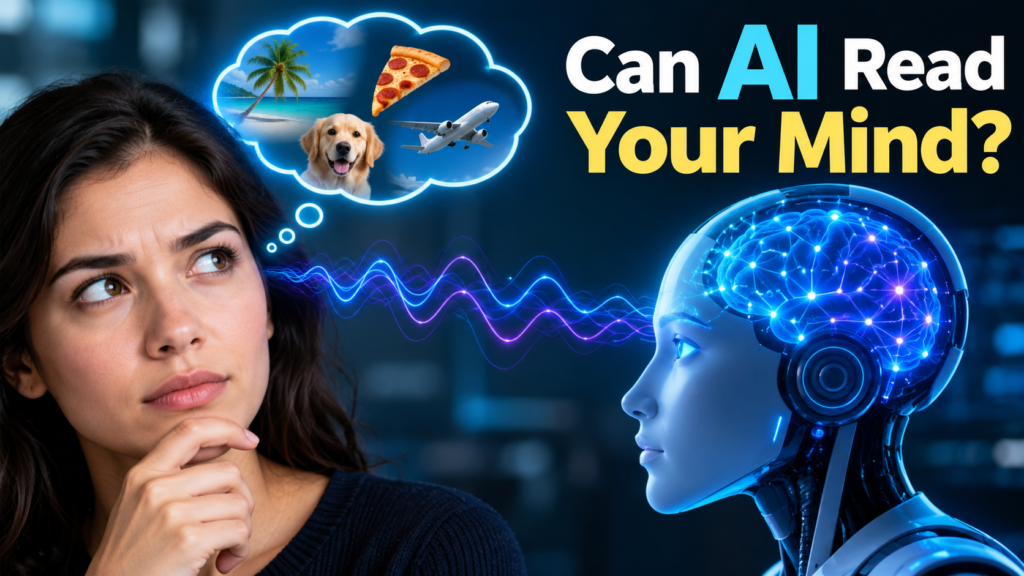
Introduction :The Question That Refuses to Stay Quiet
There is a question that once belonged to science fiction. It lived in novels in movies about surveillance states in the paranoid fantasies of people who suspected the government had a machine that could see into their skulls.. Now. Quietly insistently. That question has migrated into the real world. It sits in research labs. It sits in ethics committees. It sits in the back of your mind every time your phone suggests the word you were about to type.
Can AI read your mind?
It sounds like a fantasy. It sounds like the plot of a thriller you’d watch late at night and forget by morning. Yet in laboratories from San Francisco to Beijing in research papers with titles like “semantic reconstruction from brain activity” and “decoding imagined speech ” something is happening that makes the question harder to dismiss than it once was. Machines are beginning to decode fragments of what the brain’s doing. Not perfectly not magically, but really. Meanwhile the AI in your pocket already seems to know what you’re going to type before you type it. It finishes your sentences. It predicts your searches. It recommends the video you didn’t know you wanted. Is that mind-reading?. Is it something else entirely. Something subtler and in some ways more unsettling?
This article is about that distinction. It is about the difference between predicting behavior and reading thoughts between decoding brain signals and knowing what you mean. It is about what current AI can do what it cannot do and what the gap between those two things tells us about the human mind. And about ourselves.
We will move carefully because this is a topic where exaggeration’s easy and clarity is rare.. The stakes are real and the stakes are personal. So lets begin.
What “Mind-Reading” Actually Means
Three Different Things
Before we can answer whether AI can read your mind we have to be honest about what the phrase means. People use it to describe at three very different capabilities and confusing them is the source of most misunderstanding.
First:
predicting what you’ll do next. Your phones keyboard suggests the word. Netflix guesses what you’ll watch. A spam filter guesses whether you’ll click. This is pattern prediction based on behavior. It doesn’t require access to your thoughts. It requires access to your traces. The footprints you leave behind.
Second:
inferring your state. If you type “I’m so tired” at 2 a chatbot may infer that you’re exhausted or sad. If you pause for a time before replying a system might infer hesitation. This is inference, not reading. It’s a guess based on signals. Words, timing, tone.
Third:
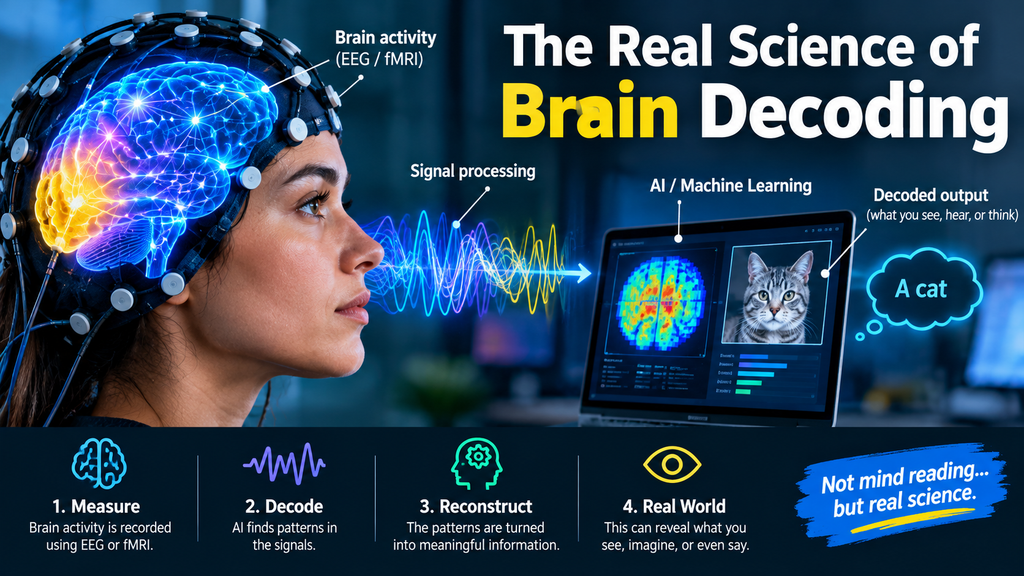
decoding the brain directly. This is the science-fiction version: putting sensors on or in your head and extracting the content of your thoughts from neural activity. This is what neuroscientists are actually working on. It is by far the hardest and most limited of the three.
When someone asks “Can AI read your mind?” they usually mean the third.. The technology they’re actually encountering is usually the first two.. That gap. Between what we fear and what we face. Is where the real story lives.
Read more: 5 Signs You Are Paying for AI Tools You Do Not Need
Why the Confusion Matters
This confusion is not harmless. It shapes fear, policy and trust. If people believe AI can already read thoughts they may. Panic unnecessarily or become numb to real risks. If they believe it can’t do anything they may ignore threats. Clarity is not just hygiene here. It is a form of self-defense.
The Real Science of Brain Decoding
From fMRI to Language Models
The genuine breakthroughs in mind-reading technology come from a marriage: neuroscience and large language models.
In 2023 researchers at the University of Texas at Austin published a landmark study. They placed participants in an fMRI scanner. A machine that measures blood flow in the brain.. Had them listen to stories imagine stories or watch silent films. Then they used a language model to translate the brain activity into words. The results were startling. The system could often capture the gist of what a person was hearing or imagining producing sentences that were close to the meaning even if not word-for-word accurate.
A follow-up in 2025 pushed further. A system called BrainGPT achieved around 40% accuracy in translating thought- brain activity into text. A number that sounds low until you realize that the previous best was closer to 3%. For the time decoding imagined speech from brain signals was becoming practically feasible at least in controlled lab conditions.
How It Works? Why Its Not Magic
Here’s the crucial thing to understand: these systems do not read minds the way a spy reads a file. They work by correlation, not extraction. The AI learns to associate patterns of brain activity with certain kinds of content. It’s a translation problem: brain signals in language out.
It only works under very specific conditions. The person usually has to be cooperating. They often have to be in a scanner, which’s enormous, expensive and requires them to lie perfectly still. The training process is intensive and personal. The model has to be calibrated to that brain.. Even then the output is fuzzy. It catches the meaning, not the words. It grasps the melody, not the lyrics.
So the honest answer to “Can AI read your mind?” is this: it can sometimes guess the shape of what you’re thinking, under lab conditions with your cooperation using bulky equipment. That is remarkable. It is also nothing like the transparency we imagine.
The Limits That May Never Break
There are limits and they matter. Brain decoding is not the same as understanding. A system can tell that you’re thinking about a dog without knowing whether you love it fear it or remember one that died. It can detect sadness without knowing its cause. It can translate signals into language without grasping meaning the way a human does.
And there is a limit: thoughts are not fixed objects waiting to be extracted. They are dynamic, distributed and constantly changing. The brain does not store sentences; it generates them in the moment. Decoding a thought is like catching a wave than reading a file.
The fantasy of total transparency. The idea that a machine could simply download your inner life. Is probably not coming. What is coming is something partial, probabilistic, easily misinterpreted access to fragments of mental life.
The Mind Reading You Live With
Your Phone Knows You Of

Here’s the part most people miss: the most effective mind-reading technology is already in your pocket and it doesn’t touch your brain at all.
Your phone knows what you’ll type next because it has watched you type for years. Your streaming service knows what you’ll want to watch because it has tracked every choice you’ve made. Your search engine knows what you’re curious about because you’ve told it thousands of times in your words.
This is called prediction and it is astonishingly powerful. Not because it accesses your thoughts but because your thoughts leak into your behavior constantly. Every click, pause, scroll and search is a confession. AI doesn’t need to read your mind. It only needs to read your traces.
The Illusion of Telepathy
This is why the experience of using AI can feel uncanny. When a chatbot finishes your sentence it feels like its inside your head. When a recommendation is eerily accurate it feels like surveillance. But in cases it’s not telepathy. It’s statistics at scale.
The danger is that this feels like mind-reading and feeling is powerful. When something seems to know us we trust it more. We open up to it. We let it influence us. The illusion of mind-reading may be more consequential than the reality ever could be. Because we respond to it as if it were true.
The Data You Give Away Without Knowing
Every day you hand over fragments of your life to systems that never asked permission. Your location. Your pauses. Your late-night searches. Your deleted drafts. Your tone. None of this is a thought, exactly.. Together it forms a portrait so detailed that it can feel like one. The question is not whether AI can read your mind. It is whether you have already let it read your life.
Where It Could Go
The Trajectory of the Technology
Miniaturization. The fMRI machines of today are the size of a room. The future may bring wearable or even implanted sensors that can read brain activity without a hospital visit. Some companies are already developing -invasive headsets that claim to detect attention focus or intent. Most are crude. The direction is clear.
Better decoding. As language models get better at translation brain-to-text systems will improve. Accuracy will rise. The need for cooperation may drop. The lag between thought and translation will shrink.
Integration with consumer devices. Imagine earbuds that read neural or physiological signals and adjust your music to your mood. Imagine a game that responds to your focus. Imagine a workplace that monitors load. None of this is science fiction anymore. It’s an engineering problem with a timeline.
The Trajectory of the Ethics
These developments raise questions about privacy, consent and control. If a device can sense when you’re stressed or distracted should employers have access to that data? Should schools use it to monitor engagement? Can you opt out. Would that make you stand out?
What happens when the line between voluntary sharing and forced observation blurs? When your own body becomes a feedback loop for algorithms that learn from your system?
The ethical challenges aren’t about the technology itself. They’re about how we define dignity, autonomy and freedom in an age where our inner livesre no longer private, by default. We’re not just building tools. We’re reshaping what it means to be human.
The question isn’t whether AI can read your mind. It’s whether we’re ready to live with the truth that it already reads the trace of our minds.. Always has.
Alongside the technology a parallel trajectory is unfolding: the ethics. Laws will be written. Norms will form. Some countries will regulate aggressively; others will not. The result will be a patchwork world where your mental privacy depends on where you live. And on who is willing to pay for access.
The Limits That May Never Break
There are limits and they matter. Brain decoding is not the same as understanding. A system can tell that you’re thinking about a dog without knowing whether you love it fear it or remember one that died. It can detect sadness without knowing its cause. It can translate signals into language without grasping meaning the way a human does.
And there is a limit: thoughts are not fixed objects waiting to be extracted. They are dynamic, distributed and constantly changing. The brain does not store sentences; it generates them in the moment. Decoding a thought is like catching a wave than reading a file.
The fantasy of total transparency. The idea that a machine could simply download your inner life. Is probably not coming. What is coming is something partial, probabilistic, easily misinterpreted access to fragments of mental life.
The Ethical Earthquake
Consent and the Problem of the Unspoken
If a machine can decode a fragment of your thoughts consent becomes a labyrinth. You can agree to let someone read your words. Can you agree to let them read what you chose not to say? Can you consent to a process that surfaces what you didn’t know you were thinking?
This is the ethical problem. Mind-reading technology threatens not privacy but the right to remain unexpressed. The freedom to have thoughts that are nobodys business. That freedom is fundamental. It is the space where identity forms. If that space closes, something about being human closes with it.
The Coercion Problem
Now add power. If a government, an employer or a corporation can decode thoughts the asymmetry becomes severe. Imagine a job interview that measures your anxiety. A border checkpoint that probes your intentions. A police interrogation that doesn’t need your cooperation. None of this requires technology. It only requires technology that is perceived as reliable.. The fear it generates.
This is why the conversation about mind-reading is really a conversation about power, not science. The question is not Can it be done?” but “Who gets to do it to whom and with what recourse?”
The Misinterpretation Problem
There is a subtler danger: false certainty. A system that decodes brain signals is a system that can be wrong.. When a machine claims to know your thoughts it is hard to argue. You cannot prove what you were thinking. The output becomes evidence. The error becomes invisible.
This is how mind-reading technology could do its damage. Not by exposing our secrets but by manufacturing them.
The Children Problem
Then there are children. A generation growing up with devices that track attention mood and focus may never know what it feels like to be unobserved. If mental privacy erodes early it may not feel like erosion all. It may feel like normal. That is the danger of all.
What It Means for Us
The Last Private Place
For most of history the mind has been the final sanctuary. The one place no one could enter without permission. AI is beginning to knock on that door. Not to break it down not yet. To knock.. What we do at that threshold will define a great deal about the kind of world our children inherit.
The good news is that the technology is still early still limited, still dependent on cooperation. That gives us time. Time to build laws, norms and safeguards. Time to decide what we will and won’t allow. Time to remember that privacy is not a luxury. It is the precondition for dignity.
The Mirror We Didn’t Ask For
There is another angle, less fearful and more strange. If AI can approximate our thoughts it is because our thoughts are patterned. Shaped by language, culture, memory and habit. In decoding us AI reveals how predictable we are. That is humbling. It suggests that much of what feels like inner life is, in fact shared structure. The common grammar of being human.
The question then is not Can AI read our minds?”. What does it mean that our minds can be read at all?” The answer may be that we are less singular than we believed. And more connected. That is either terrifying or beautiful depending on how you look at it.
The Choice We Still Have
And here is the thing: we still have a choice. The future of mind-reading is not predetermined. It will be shaped by laws by norms by what we demand and what we refuse. The technology is coming. The question is what kind of society we build around it. One that treats the mind as a resource to be mined or one that treats it as a sanctuary to be protected. That choice is ours. For now.
Conclusion:
So: can AI read your mind?
Yes, in the sense that it can decode fragments of brain activity under controlled conditions and it can predict your behavior with accuracy from the traces you leave behind.
No in the sense that it cannot access your life directly cannot understand your meaning the way you do and cannot simply download your thoughts like files.
The truth is stranger, than either extreme. We are living in a moment when the boundary of the mind is becoming porous. Not shattered, but porous. The technology is real the limits are real. The choices ahead are ours.
The question is no longer whether machines can read our minds. The question is what we will do with the fact that they are beginning to try.
