

Introduction
Have you heard of cases where the same AI assistant gives completely different answers to two different people? One gets a detailed, nuanced, fully formed response while the other gets generic, bland, textbook filler. It’s not always the AI’s fault, either. The truth is, many AIs are incredibly good at answering based on the prompt provided. They can only give one, though, and their responses are dictated by the precision and care taken in the request. This article details 7 simple but effective techniques that can help you get better answers from AIs.
Trick 1: Ask the AI to Interview You First
Asking a question is normally how an interaction begins. Instead, try ending your initial prompt with “Before you answer, please ask me every question you need to in order to give the best possible response.”
You may be surprised by how much the AI asks you. It may ask you 10-15 questions before providing an answer. Once it finishes asking, answer as many as you can. When it replies, it will provide a better response than it might have otherwise.
Reason: The AI only knows what you tell it. By asking it to first interview you, you enable it to get crucial information from you before it has to provide an answer.
Trick 2: Make It Think Step by Step
AIs tend to jump to conclusions. In certain circumstances, this can lead to wrong answers. This is especially common any time the response requires logic or analysis. What most people don’t realize is that the fix to this problem is almost embarrassingly simple. Simply add “think step by step” or “show your reasoning before giving the final answer” to your prompt.
What this does is cause the AI to reason out its response in the exact same way a human would have. Studies on large language models have shown that this technique can drastically reduce errors on analytical questions. At the very least, you can see where the AI is coming from, and if it takes a wrong turn at step 2, you can correct it before it reaches the final answer.
Reason: Many problems are too big to solve at once. By making the AI think step by step, you enable it to break the problem into smaller, more manageable chunks.
Trick 3: Make It Hold a Debate
One of the most frustrating flaws of AIs is their confidence in their answers. It can appear that there’s only one valid answer to a question, when in reality there are many viewpoints to consider.
To do this, try asking the AI to facilitate a debate. For example, you might ask “Imagine a roundtable discussion with an economist, a psychologist, a technologist, and a strategist. How would each of them view this problem, and what would they say about it?”
Instead of a bland, one-sided answer, you will find that the AI’s response will now take multiple viewpoints into account. The most interesting parts are usually where the different “opinions” clash, as it highlights the strongest arguments for either side of a debate.
Reason: The best way to see the effects of a change is to look at it from different angles. AIs can be prompted to do this by asking them to have a debate.
Trick 4: Ask It to Take on Specific Roles
Requests such as “you are a marketing expert” are often not nearly as useful as they seem. This is because such vague roles don’t provide much structure for the AI.
A much better approach is to dictate specific roles. You could ask the AI to be a science teacher who specializes in teaching complex ideas to 12 year olds with short attention spans, for example. Such a prompt will yield better results than simply telling it to be a teacher.
Reason: Roles can be a useful tool in narrowing the scope of what the AI has to say. It’s important to specify the role, however, as simply saying the AI is to be an expert can lead it to be overly defensive and stiff.
Trick 5: Have It Help You Write Your Own Prompt
This trick is so good because it helps you utilize the previous tricks without even having to ask for them. You can ask the AI to “write the best possible prompt I could use to get [describe your goal]. Please include any role, format, constraints, and context that would help achieve that goal.”
This allows the AI to craft a better prompt, which is subsequently used to actually provide the answer you were initially looking for. Think of it as hiring the AI to be your personal human assistant.
Reason: You’re using the AI’s abilities to help you get better results from the same AI
Trick 6: Specify the Format You Want the Answer In
AIs tend to ramble if you don’t tell them not to. This is especially evident when they don’t know what format to put your answer in. They can be easily coerced, however, into putting their answer in a specific format. Instead of simply asking it to analyze a problem, ask it to “give me 3 reasons, each in 1 sentence, and a table comparing Option A and Option B.”
You could also ask the AI to help you by prefacing the answer. This means writing the first line or lines of the answer yourself. Afterward, the AI will continue in the same vein, writing in the same style and adhering to the constraints you set.
Reason: By putting the answer in a specific format, you’re telling the AI exactly what you want it to say without having to ask it for those specifics.
Trick 7: Ask for Multiple Independent Solutions
When you ask an AI to provide the best solution to a problem, it can be hard to know whether it actually did so. It’s always possible that the AI simply gave you the first idea that came to its mind, without considering other options. A much better approach is to ask for multiple independent solutions. You could ask for 5 logically independent approaches to solving this problem, with a success probability for each.
When asked to come up with multiple solutions, the AI has to put more effort into it to meet your request. It will also be forced to reveal how confident it is in each solution, as well as the areas in which it is unsure. A good way to test this is to ask 3 variations of the question and see whether the responses are consistent. If they are, the solutions are likely to be reliable.
Read more:AI Where Humans Can’t Go
Conclusion
All of the tricks outlined above share one fundamental similarity. They all ask the AI to think about the question in a specific way that makes it possible to provide a better answer
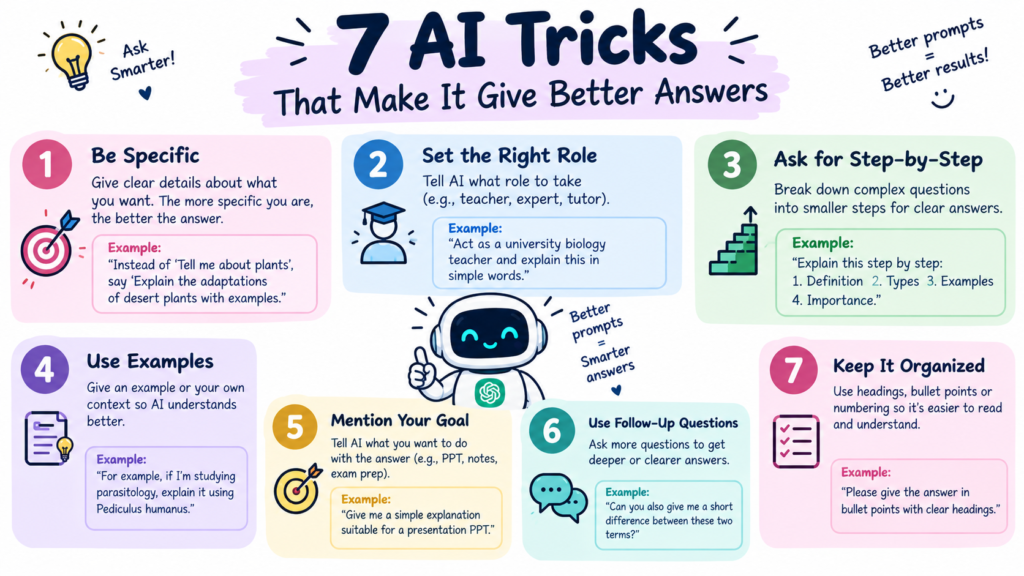
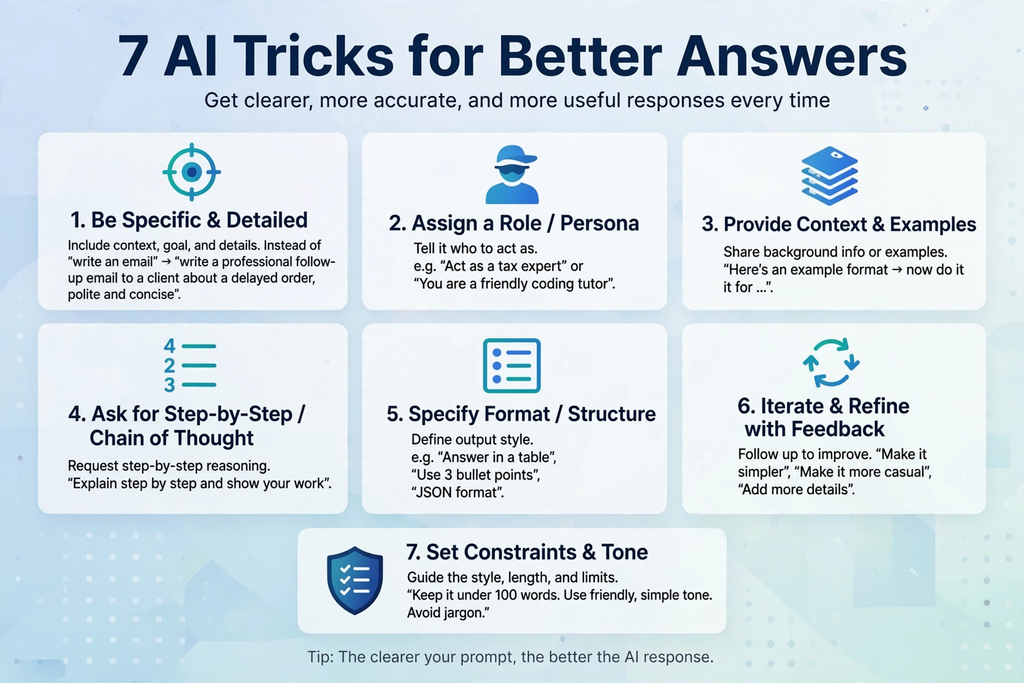
Using these tricks can help you get answers that are easier to implement, better structured, and, on average, overall better. Not only that, but they are extremely simple to implement and can be used right away. Here’s a summary of all 7 tricks:
Ask the AI to interview you first
Tell it to think step by step
Make it host a debate
Ask it to fulfill specific roles
Have it help you write your own prompt
Tell it to put its answer in a specific format
Ask it to provide multiple independent solutions
While it may seem daunting at first to ask AIs to think in these specific ways, there’s an important lesson in all of this. AIs are not magic balls that read your mind. They are thinking entities that can be guided. All you have to do is guide them.
