

Introduction
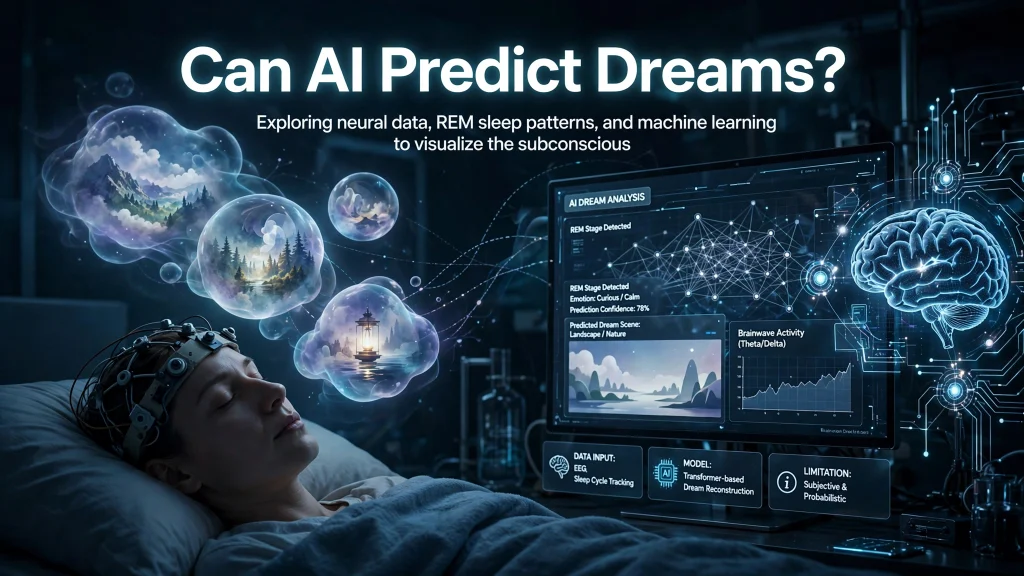
Dreams have fascinated people for thousands of years. Their short and personal nature has made them very hard to study scientifically. For most of time the only way to know about a dream was through the dreamers memory after waking up. This method has problems with memory being wrong things being forgotten quickly. The problem that no one can check if the dream report is accurate. The question of whether artificial intelligence can predict dreams brings together neuroscience, machine learning and consciousness studies. This could change this hard to study area into something that can be studied with experiments.
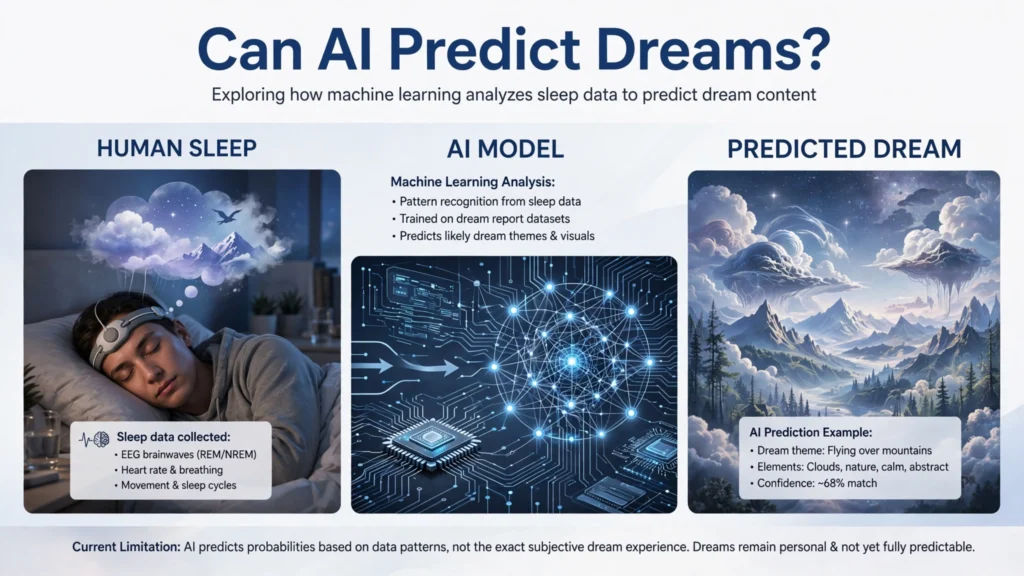
Recent progress suggests the answer is yes. With some important limits. AI systems can now know when a person is dreaming figure out what they are dreaming about in a way and even make dream-like stories. However the idea of a dream recorder” that plays back dreams like a movie is still in the world of science fiction. This article looks at the state of dream prediction technology the methods used the main limits and what these changes mean for our understanding of being awake and aware.
The Scientific Challenge of Dream Prediction
Why Dreams Are Difficult to Understand
Dreaming happens in a state of being awake that’s very different from when we are awake. The brain during dreaming has experiences, more feelings and parts of the brain that help with memory and attention are less active. This means that dreams are not just like videos in the mind that can be seen like a movie. They are made experiences, built from brain activities and their content is only partly known even to the person who had the dream.
A main problem is that there is no sign that definitely shows a dream is happening. A review says that researchers cannot be sure if a dream happened before waking or much earlier with the dream content staying in memory until the person wakes up. Also if there is no dream report that does not mean there was no dream. It might just mean the dream was not remembered. This confusion has led to different results about the brain signs of dreaming.
From Seeing to Predicting
The move from looking at dreams after they happen to predicting them before they happen became possible because of two things. First high-density EEG and MEG let researchers see brain activity with detail to find patterns linked to reported dream content. Second machine learning algorithms could take these patterns from complex data and learn to connect certain brain states with certain experiences.
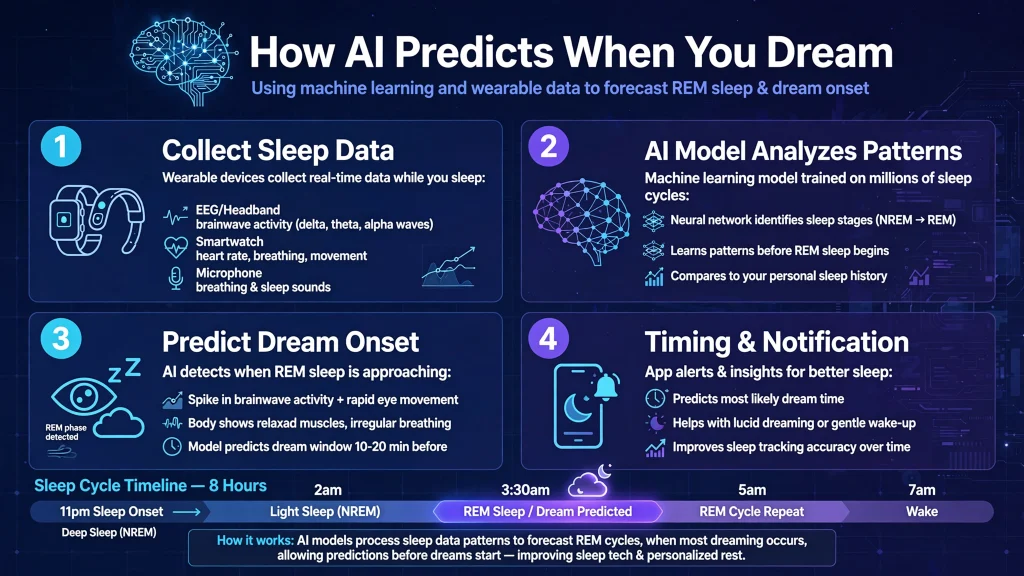
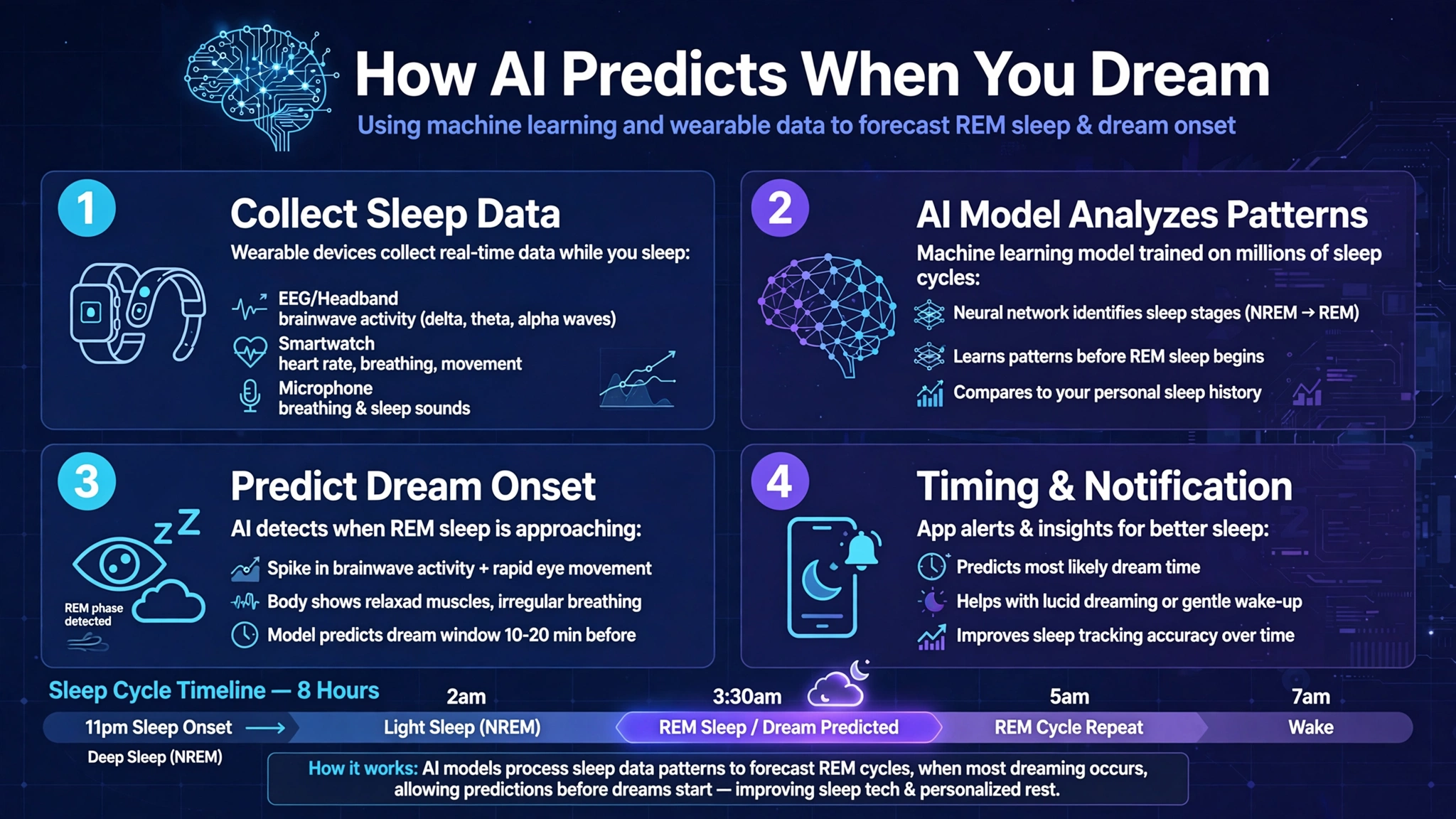
How AI Predicts When You Dream
The DREAM Project and Big Data
The biggest recent step forward in predicting dreams comes from the DREAM project, a group of 53 experts from 37 places in 13 countries. This project collected than 2,600 times when people woke up from 505 participants taken from 20 earlier studies into one big database of brain recordings and detailed dream reports.
Using high-quality brain recordings segments of least 20 seconds and frequencies higher than 100 Hz researchers trained algorithms to find the brain patterns before each time someone woke up. The results showed that AI could predict when a person was dreaming with a level of accuracy without needing the person to report it. This is important because it allows checking for dreaming in people who can’t talk like those in a coma or under anesthesia.
Beyond REM Sleep
One of the DREAM projects important discoveries challenges the usual idea that dreaming only happens in REM sleep. Dreams also happen in NREM sleep in the early night or just before waking. The AI models trained on this complete data could find dreaming in all sleep stages not just during REM periods.
This matches research showing that dreams during both REM and NREM are linked to lower activity in the back part of the brain with higher activity linked to parts of the dream content. The signs of dreaming are spread out. Depend on the sleep stage not tied to one stage.
Brain Reading During Sleep Start
The successful attempts to predict dream content came from Japanese research using fMRI. Scientists at the ATR Computational Neuroscience Laboratories in Kyoto watched participants brain activity when they started to sleep then woke them up during REM sleep to ask what they had been dreaming about.
By linking what people said they dreamed about with patterns in the part of the brain the researchers trained an algorithm to guess what they were dreaming about with about 70% accuracy for some types of content. These guesses were tested against what people said when they woke up which was a progress in getting dream content from brain activity alone.
Limits of Content Reading
with the good accuracy numbers the things AI can predict now are very limited. The Japanese studies only looked at images in a small number of people and only for short times during the start of sleep. The algorithm does not show a picture; it just picks the best match from a small list of possible categories.
Recent work has looked at decoding during lucid REM sleep, where specific hand movements in dreams used the same parts of the brain as when someone is awake.. One review says that these results show that internal experiences can use some of the same brain parts as when seeing things but they don’t show a full dream movie has been read. They give looks at a bigger picture.
Dream Making: The Other Way Around
Can AI Make Dreams?
Another area of research asks not if AI can read dreams. If it can make them. Researchers have looked into whether language models like ChatGPT can create real dream stories. In one study ChatGPT-4o made all the dreams that were asked for. These made-up dreams met important traits of real dreams suggesting that LLMs can copy some parts of dream experiences.
These results are seen as setting up a task for LLMs with possible uses in helping psychologists look at patients dreams based on who they are. This work is important because it asks the question: instead of reading brain activity into dream content it asks if dream-like experiences can be made from patterns in text.
The Unexpected Predictability of Dreams
A surprising discovery from research is that dream reports are actually more predictable than normal text at least from the point of view of big language models. Using a measure called perplexity which shows how “surprising” a sequence of words is to a model researchers found that dream reports from the DreamBank database had lower scores than Wikipedia articles.
This means that even though dreams are known for being strange they follow story and language patterns that LLMs can follow. The research also found that perplexity scores were different for reports from men and women and for sighted people showing that LLMs know about group differences found in dream studies before. This has both theory effects (dream reports are easier to work with than thought) and suggests that dream content may be more organized and shaped by culture than it seems on the surface.
Read more:How AI Is Helping Discover New Uses for Old Medicines
The Brain Science Behind Predicting Dreams
Why Prediction Is Possible
The ability to predict dreams depends on an idea from brain imaging: experiences made up in the mind use some of the same brain parts as when we see things. Machine learning models trained on fMRI patterns can guess what people see while they are falling asleep better than chance. There are similar patterns between what people see and what they imagine.
This means that activity in the brain when a person dreams a face is similar to when they actually see a face. The dreaming brain is not making things out of nothing; it is. Mixing up parts that were made when the person was awake.
Lucidity as a Research Help
Lucid dreaming, when a person knows they are dreaming while still asleep has become an useful tool in dream prediction research. Lucid dreamers can use eye movements to show when something happens in the dream, which helps later analysis. Four labs have shown two-way communication during proven REM sleep with some dreamers getting questions thinking of answers and sending signals.
More recent work has used nose patterns to tell about dream-eye position. What is seen in real time recording 150 signals from 11 people in 19 sessions. While these results are more of a test than a way to read dreams for everyone they show that dream content can be checked during sleep giving data for AI prediction tools.
Big Limits and Ethical Issues
What AI Cannot Do
big problems stop AI from predicting dreams completely. First there is no sign that shows a dream is happening. The real data used to train the models the dream report is not reliable. Dreams are forgotten quickly. Reports are guesses, not exact copies.
Second even the best decoding methods only get part of the dream experience. The Japanese fMRI studies had 70% accuracy for a types of visual content not for the whole range of dream stories feelings and senses. One review says the results give views of a bigger picture, not a full dream movie.
Third, the brain processes that make dreamsre not in one specific area. Dreaming involves a spread out state- setup with parts of the back brain emotion areas and parts of the front brain, among others. This spread makes it very hard to understand.
The development of dream prediction technology brings up ethical questions. If dreams can be understood, in part what happens to private thoughts? The Oneiris project, which uses AI along with Lakota symbolic frameworks directly deals with issues of cultural respect correct understanding of symbols and the chance of using culture in the wrong way. The projects way of working asking for permission and keeping in touch with Indigenous partners shows a good example of how to work with dream technologies in an ethical way.
Generally the money-making possibilities of dream recording tools raise worries about keeping data safe and making sure people are mentally okay. Patent papers talk about systems that would let people choose the dreams they want like “swimming in a sea at 20 meters deep” and give feedback to make dreams better. Even though these tools might help people feel better they also bring in ways for companies to affect the things people experience when they are not awake.
Conclusion
The question of whether AI can predict dreams has an answer. AI can now tell when someone is dreaming with a lot of accuracy using collections of brain recordings. It can find some types of dream content like things you see with some accuracy in lab settings. It can make stories that feel like dreams and meet the rules that make something a dream.. It can look at reports about dreams very easily showing that dreams are more predictable in language than people think.
What AI still can’t do is make a smooth dream experience like a movie. The main reasons are not about technology but about ideas: dreams are personal spread out and not fully known even by the person who had them. The dream report is still the way to know what happened and it is never complete.
The biggest progress in predicting dreams has not come from one invention but from combining lots of data, detailed brain scans and smart computers. The DREAM project bringing together thousands of dream reports is a change similar to the Human Genome Project, in how it wants to create a shared place for scientists to use. Whether this will let people fully understand dreams is not clear. It has already made the study of dreams go from something not many cared about to something full of data. The sleeping brain as one person said, is finally starting to share its secrets.
