

Introduction
If you type one sentence: “A lighthouse keeper who talks to the sea”. Into an AI system today you will receive a story, a piece of concept art a character sketch or even a fully voiced audio scene within seconds. What once required a writer, illustrator or designer many hours or even days of work now appears from a words typed into a chat box. AI feels like magic. But AI is not magic AI is the result of years of study in language modeling, pattern recognition and probabilistic reasoning packed into a system that can take a human idea and unfold it into something rich, detailed and coherent.
This transformation, from a prompt to a structured world is one of the most fascinating aspects of modern AI. By seeing how it happens we learn not about the technology but about creativity itself: how ideas grow how context builds meaning and how ambiguity can be a strength rather than a weakness.
What Do We Mean by “Simple Prompt” and “Complex World”?
Before exploring the mechanics it helps to define the terms.
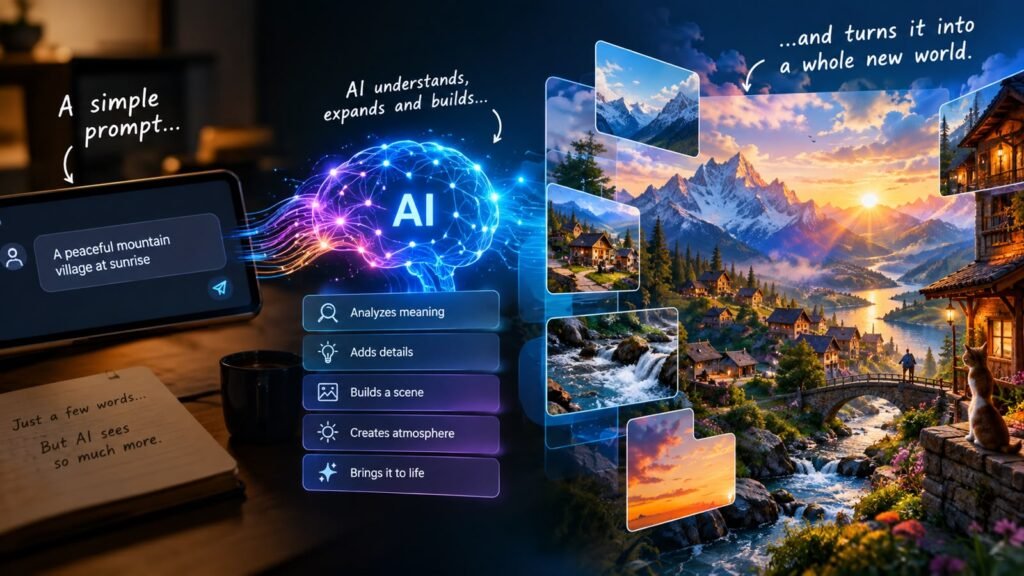
A simple prompt is often an instruction. A. Two that shows an intent but leaves most details out. “Write a story about a robot who wants to be human” is a prompt. The simple prompt does not give the robot’s name, the setting, the tone, the ending or the theme.
A complex world in this context is the realized output: a narrative that has characters, settings, internal logic, emotional arcs and consistent details.. For visual AI an image with clear lighting, spatial relationships and style choices. A complex world is the difference between a seed and a forest.
The gap between these two is where the interesting engineering takes place.
Read more:How AI Is Changing Teen Slang
The Building Blocks: How AI Models Understand Prompts
Pattern Recognition at Massive Scale
Large language models are trained on amounts of text. Books, articles, dialogue, code and more. During training the model does not memorize facts like a database. Instead the model learns relationships: which words, phrases and ideas tend to follow others in which contexts. This means that when you give the model a prompt the model does not look up an answer. The model predicts, piece by piece what a coherent continuation would look like based on everything the model has learned about how language and stories work.
This is the key to expansion: the model has a hidden library of narrative structures, world‑building conventions and stylistic patterns that it can draw from even if you never mentioned them explicitly.
Filling in the Gaps with Learned Defaults
When a prompt is vague the model does not pause. The model fills in gaps using defaults learned from the model’s training data. Ask for “a fantasy kingdom”. The model will likely add castles, magic systems and political intrigue because these are the patterns linked to that genre in the text the model has seen. This is not guessing. This is informed inference, shaped by the shape of stories.
From Words to Worlds: The Expansion Process
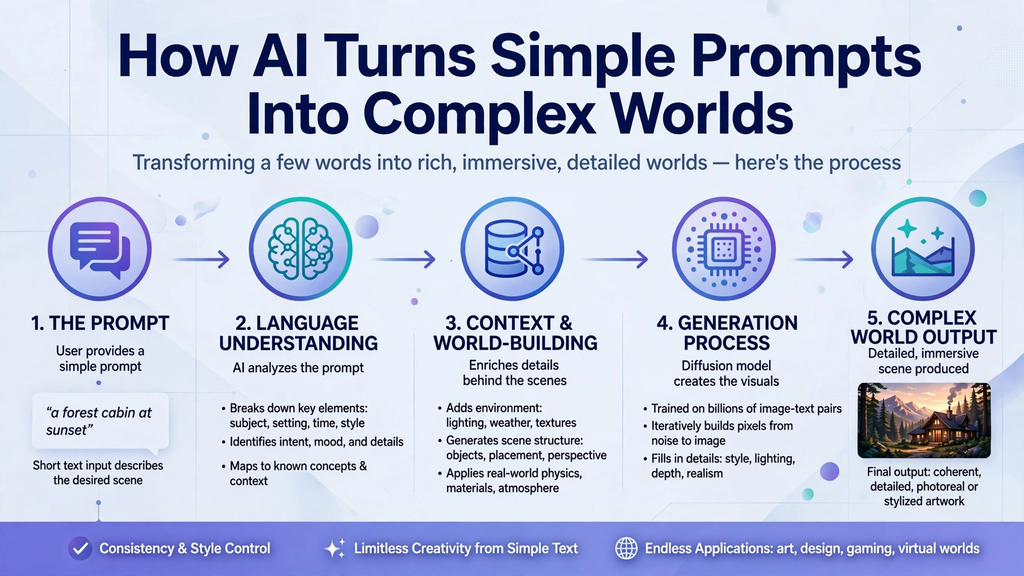
Step One: Intent Extraction
The thing an AI system does with a prompt is try to identify the core intent. Does the user ask for a story a plan, an image, code or an explanation? Even a short prompt carries signals. Verbs like “write” “design”. Imagine” hint at the expected format and depth of the answer.
Step Two: Scaffolding a Structure
Once the intent is clear the model builds a scaffold. For a story this might mean a three‑act structure: setup, conflict, resolution. For an image generation model this might mean composing a scene with a foreground subject, background context and lighting scheme. The scaffolding step is crucial. This step stops the output from becoming a pile of details. Instead makes it feel like a unified whole.
Step Three: Layering in Detail
With the framework, in place the model starts adding details: names, descriptions, dialogue, motivations, visual textures. Each added detail is chosen not randomly. The model chooses each detail based on what fits with everything the model has already created. This is why AI‑generated worlds often feel surprisingly consistent. The model keeps looking at its earlier output to keep logic and style in line.
Step Four: Iterative Refinement
Many AI systems conversational ones do not just generate once. Stop. They keep refining especially when a user asks follow‑up questions or nudges the output (“make it darker” “add humor” “give the character a flaw”). Each time the model adds another layer of detail turning a sketch into a multi‑dimensional creation.
Why Small Prompts Can Produce Such Rich Results
Compression of Cultural Knowledge
Every taps into a huge reservoir of cultural and narrative conventions the model has absorbed. When one says “story” the prompt calls on noir tropes, moral ambiguity and a particular pace. The prompt does this without having to spell it out. AI acts like a compressor‑decompressor: the prompt’s few words unzip into an entire tradition of storytelling.
The Power of Ambiguity
Ambiguity far from being a weakness actually gives the model room to be creative. A prompt with constraints limits the space of possibilities; a prompt with just enough openness lets the model explore many plausible paths and pick the most coherent one. This is part of why short prompts yield imaginative results. The model has freedom to connect ideas you did not anticipate.
Emergent Behavior from Simple Rules
As complex ant colonies grow from individual behaviors complex AI outputs grow from relatively simple underlying mechanisms. AI predicts the most probable token or pixel over and over guided by the prompt. No single step in the process designs a world; the complexity grows from thousands of decisions.
From Words to Worlds: The Expansion Process
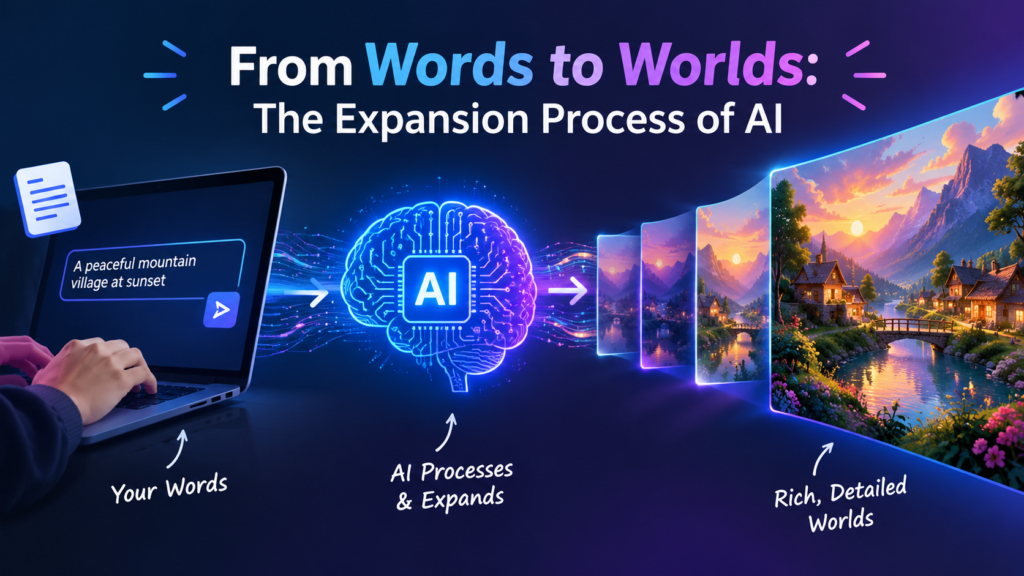
It is worth noting that this process is not purely automatic. The human prompter plays a role. The way a question or request’s phrased shapes the whole path of the output. This has led to what many call ” engineering.” The skill of making inputs that guide AI toward creative destinations. A skilled prompter can act like a film director giving enough guidance to shape a scene without dictating every detail letting AI’s generative strengths fill in the rest.
Limitations and Challenges
This process is not flawless. AI‑generated worlds can suffer from:
– Inconsistency over outputs
Details introduced early may contradict details introduced especially in longer narratives.
– Generic defaults.
Without specific guidance models often default to sometimes clichéd patterns since these are statistically dominant in training data.
– Lack of understanding.
The system does not “know” its world exists; it is simulating plausibility not holding a model in the same way a human author might.
These limitations are gradually being addressed by improvements in memory, context length and structured reasoning. They remain part of the tradeoff involved in this kind of world-building.
Conclusion
The journey from a prompt to a coherent world shows something deep about both artificial intelligence and human creativity. AI does not build these worlds from nothing. AI draws on stores of learned pattern, structure and convention using a words as a seed to unlock a vast space of possibility. In doing AI acts like a magician and more like a highly skilled collaborator: one who listens to a spark of an idea and knows exactly which patterns, structures and details will make that spark burn into something whole.
As these systems continue to evolve the line between “prompt” and “complex world” will likely become even thinner. But the underlying principle will stay the same: complexity does not have to come from instructions. Sometimes all it takes is a question and a system smart to imagine everything in, between.
