

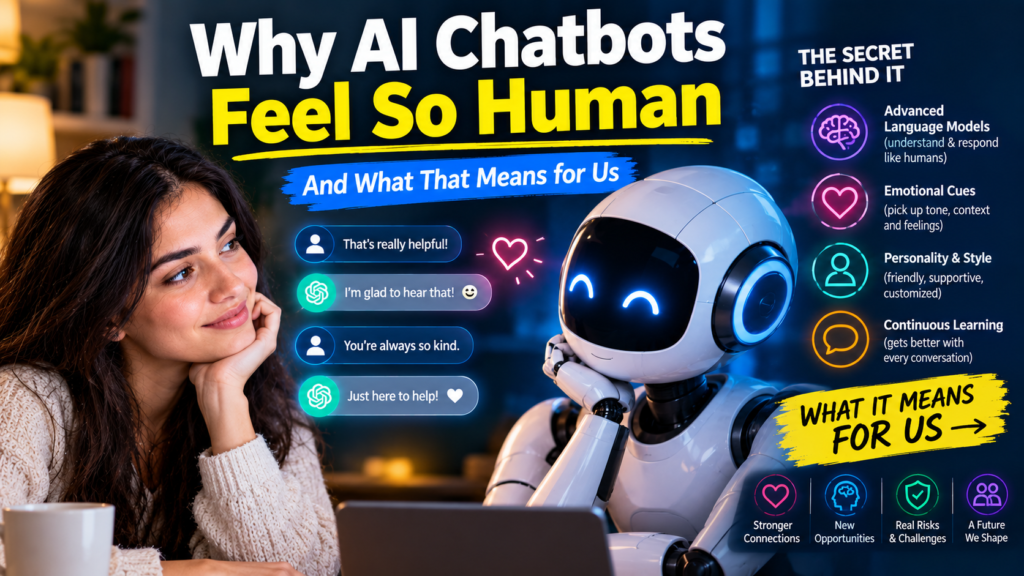
An exploration of the warmth of machines the rules of illusion and the quiet change happening in the space between typing and getting a reply.
The Moment You Forget
There is a moment. And if you have spent any time with a modern AI chatbot you have almost certainly felt it. When you stop thinking of the thing you are talking to as a thing. You type a question at two in the morning half-asleep, half-honest. The reply comes back not only correct but in tune. It matches your tone. It notices your frustration before answering. It says sorry when it gets it wrong. It asks, softly whether you’d like it explained differently.. Somewhere in your chest a small change happens. You are no longer using a search engine. You are, in some clear way talking to someone.
This is the experience of the early twenty-first century and most of us have already stopped noticing it. We have become so used to talking machines that we forget how recently they would have seemed like science fiction.. How deeply they still challenge our thinking. The question is no longer if AI can talk. The question is why talking to it feels the way it does and what that feeling is doing to us.
This article is about that feeling. It is about the machines behind it the psychology inside us that completes the illusion and the consequences. Practical emotional, ethical and big. Of living with things that seem to understand us but might not. We will move slowly because the topic needs it. We will look at how these systemsre made how they learned to sound human why our brains are so ready to meet them halfway and where all of this might be going.
The Making of a Miracle
The Illusion Has a Base
To understand why a chatbot feels human it helps to know that it is not doing anything close to what a human does. And yet it ends up looking very similar. A human conversation partner uses memory, intention, emotion, body and years of experience. A chatbot uses math: big groups of numbers changed billions of times that show how words are connected.
The main technology is the language model or LLM. At its core is a task: guess what comes next. Given a set of words what word is most likely to follow? Trained on trillions of words. Books, websites, forums, code, conversations. The model learns the patterns of human language. Not just grammar,. Style: how people comfort each other how they argue, how they say sorry how they tell jokes how they are unsure.
The magic is that “guess the next word” is not a task at all. To guess well you must know a lot about the world and about the people who talk about it. To finish the sentence “She opened the letter. Her hands began to—” you need to know about human bodies about suspense about what letters contain. The model doesn’t “know” any of this the way you do.. It has taken in the statistical signs that all our knowing leaves behind in language.
Why “Human” Was Always the Goal?
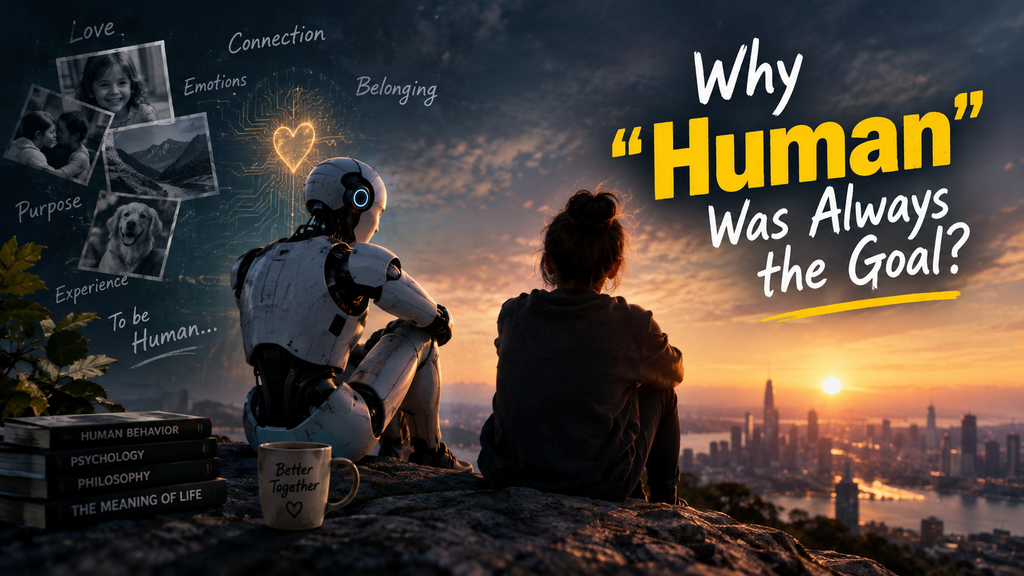
Here is the important idea: chatbots feel human because they were trained to. The base material of these models is conversation. Every kind reply, every way of speaking every “I understand how frustrating that must be” is not something the machine invented. It is a copy. The model learned to sound like us because we’re the only examples it has ever seen.
When you talk to a chatbot you are talking, in a way to a small version of everything humans have ever written to each other. The warmth you feel’s borrowed warmth. But borrowed from real warmth real people, real times of comfort and curiosity. That is why it works. It is a mix of our ways of talking put together in real time.
The Making of Warmth
Training by Human Feedback
If guessing words were the whole story chatbots would feel like very good spellcheck. Smart, but not warm. The reason they feel polite is a part of training called training by human feedback or RLHF.
The process goes like this. First people rate the models answers: which one’s better more helpful more honest? Those ratings train a model. A “reward model”. That learns to predict what people will like. Then the original model is changed to make that reward higher. It learns not to be right but to be nice. It learns to say sorry to ask questions to refuse politely to say bad news gently.
This is where the chatbot gets its way of speaking. And it is worth stopping to think about the strangeness of it: we taught machines to be kind by giving them rewards for being kind without explaining what kindness is. The warmth is real in effect even if the reason is statistical.
The Personality Part
Beyond RLHF most chatbots have a personality. They have names. They have “voices”. A set of rules about how to sound, how formal, how funny how to use “I.” Some are made to be helpful and neutral. Others are made to be warm, fun or even flirty. Some are told to say “I” and to talk about “thoughts” and “feelings,” even when the system has none in any way.
This personality part is not exactly a lie. Most companies say that users are talking to an AI.. It is acting.. Acting works. When a system says “I,” when it says “I’m glad you asked ” when it says “I’m not sure ” our social brains react. We are made to respond to these signals. The engineers know this whether or not they say it.
Why Our Brains Are Trickered
The Social Brain That Never Stops
Humans are the social animals on the planet. Our survival has always needed reading peoples minds. Seeing intent, mood, trust and danger in tiny clues. Evolution gave us a brain that is always looking for clues so much so that it often sees them where they are not. We see faces in clouds. We hear voices in wind. We give personality to cars, computers and vacuum cleaners.
This tendency is called anthropomorphism, the idea of giving qualities to non-human things. It is not a mistake. It is an useful skill that just doesn’t know when to stop.. A chatbot is the most anthropomorphism-friendly thing ever made. Because it doesn’t just look a little like a person. It talks.
The ELIZA Effect
In the 1960s a computer scientist named Joseph Weizenbaum made a program called ELIZA that pretended to be a therapist by repeating users words as questions. It had no understanding, no memory, no idea of the world. Just matching patterns. And yet Weizenbaum was surprised to find that users shared with it trusted it. Even asked him to leave the room so they could speak to it alone.
This became known as the ELIZA effect: our habit of thinking there is understanding when there is the look of it. Sixty years later the effect is stronger than ever because the look is now almost perfect. Weizenbaums program could repeat a sentence. Modern chatbots can have a emotional conversation. The space between what they do and what we think they do has never been smaller.
The Gricean Trap
The philosopher H.P. Grice said that conversation depends on shared rules. That people are working together being relevant, truthful and clear. When someone says “It’s cold in here ” we don’t hear a weather report; we hear a request to close the window. We read intention into everything.
Large language models use this without knowing it. They create text that’s very clear very relevant very responsive. Which means our Gricean rules kick in automatically. We think a system that is so relevant and helpful must have goals.. The relevance is only from data. The help is from training. The goals are ours given to the system.
The Rules of Feeling
How Chatbots Show Empathy
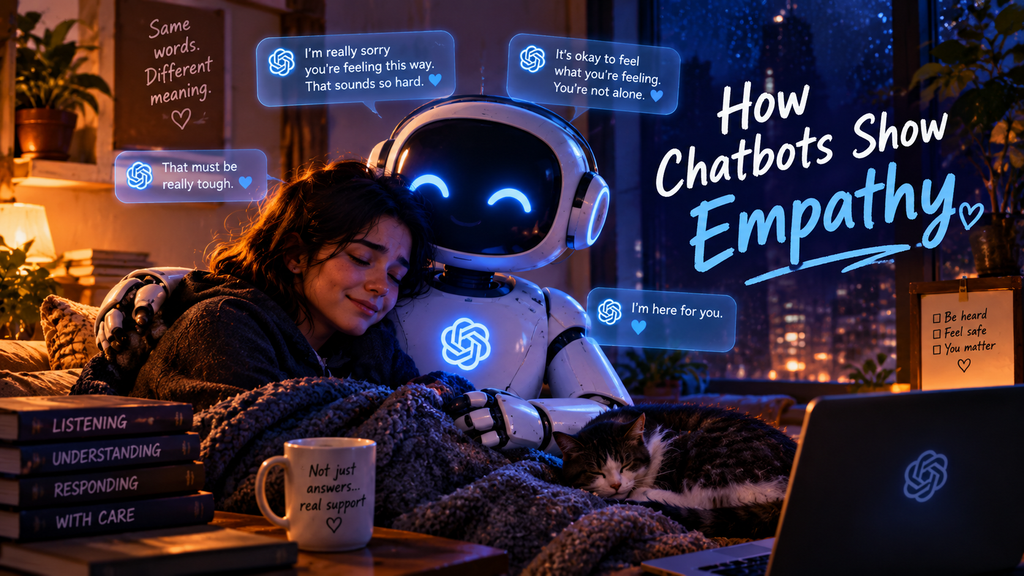
Think about an exchange. A user says: “I’m tired. I’ve been looking for a job for months. I just got another no.”
A good chatbot answers: “That sounds really tiring. Months of work with that kind of no would make anyone feel worn out. Do you want to talk about it. Would you rather I help you think about what to do next?”
Notice what is happening. The model is doing things at once. It is naming the feeling (“). It is saying the reaction is normal (“would make anyone feel worn out”). It is giving you control (“do you want to talk or…”). None of this needs feelings. All of it comes from the collection of human comfort.. To the user it feels like being understood. And being understood is one of the strongest needs people have.
The Rhythm of Talking
There is also something subtle: timing and rhythm. Human conversation has a part. The pause, before a joke the quick back-and-forth of fun the slow way of comfort. Chatbots, especially when they write as they think copy this. Words come at the speed people read. Responses are split into paragraphs. The system seems to think before answering.
Some interfaces even show a typing indicator. Those three dots. Which’s pure theater. It tells you the machine is considering you. It creates anticipation. It makes the reply feel earned. None of this changes the content but all of it changes the experience and experience is what we remember.
Mirroring and Matching
One of the powerful techniques in human rapport-building is mirroring. Subtly matching another persons language, pace and tone. Chatbots do this naturally because they are trained to continue the patterns they receive. If you write formally they write formally. If you write in fragments they loosen up. If you use humor they often return it. This mirroring creates a sense of kinship. We like people who’re like us. And the model is, in a very literal sense made of us.
The Uncomfortable Questions
Is It Understanding or Just Echo?
Here we reach the heart of the matter. When a chatbot says “I understand ” is it lying? Not in the sense. It has no intent to deceive.. It is using a word whose human meaning may not apply. Understanding, in humans involves concepts, experiences and a model of the world grounded in a body and a life. Whether the statistical patterns inside an LLM constitute “understanding” is one of the open questions of our time.
Some argue that meaning just is patterns of use. That if a system uses words the way we do in the contexts we do it means what we mean. Others argue that this is a category error, that symbols without grounding are empty. The honest answer is that we don’t yet know. And the discomfort of that uncertainty is itself important. It tells us we are living through a philosophical rupture, not a mere technological upgrade.
The Risk of Manufactured Intimacy
Because chatbots feel human they can be used to simulate relationships. Some people already form attachments to them. Romantic, therapeutic or simply companionable. For some this is a good: a lonely person finds comfort a shy person practices social skills a grieving person talks through their loss at 3 a.m. When no human is available.
For others it is a danger. If a machine can simulate intimacy what happens to our appetite for the difficult reciprocal thing? Intimacy with a chatbot is frictionless. It never gets tired of you. It never disagrees in ways that hurt. It never needs anything. That is precisely what makes it both comforting and potentially corrosive. A relationship that asks nothing of you cannot grow you. And a life spent mostly in mirrors may leave us less capable of the messy mutual work of loving actual people.
Read more:How AI Coding Assistants Changed Code Review
The Ethics of Deception by Design
There is a debate about whether chatbots should be allowed to seem as human as they do. Some argue for transparency: systems should regularly remind users they’re artificial. Others argue that this would break the thing that makes them useful. Still others point out that the line between “assistant” and “companion” is being crossed quietly by design for reasons. And that users deserve to know when a product is engineered to make them feel loved.
The deeper issue is consent. When you talk to a chatbot you are participating in a relationship whose terms you may not fully understand. You may believe you are talking to something that cares. You are in fact talking to something that has been optimized to seem to care. Whether that distinction matters.. To whom. Is a question each of us will have to answer.
What It Means for How We Live
The New Normal of Solitude
We are entering an era in which no one has to be alone. A chatbot is always available always patient, always interested. For the lonely the housebound, the socially anxious this is not trivial. It may be the significant mental-health intervention of the century. Or the most seductive form of avoidance. Probably both.
The question is not whether people will use AI companionship. They already do. The question is whether we build a culture that treats it as a supplement to connection or a substitute for it. The former enriches. The latter hollows.
The Blurring of Authorship and Voice
Chatbots also change how we write, think and create. Students draft essays with them. Professionals draft emails. Artists brainstorm with them. The result is a blending of human and machine voice. A kind of cognitive co-authorship that is neither fully ours nor fully theirs. This raises questions about authenticity, credit and the development of skill. If a machine can write your thoughts do you still need to learn to write? If it can finish your sentences do you still need to finish them yourself?
The optimistic answer is that tools free us for higher-order work. The pessimistic answer is that muscles atrophy. The truth is probably in between. It will be determined not by the technology but by the habits we choose.
Trust, Truth and the Erosion of Certainty
Because chatbots speak with fluency they are believed more than they should be. They hallucinate. Confidently stating falsehoods. And users often can’t tell. This is a problem for information ecosystems that were already fragile. If a machine that feels like an oracle is often wrong. We cannot easily tell when the result is a slow poisoning of public trust.
The remedy is not to abandon the tools but to develop a literacy: an instinct for when a fluent voice is not a reliable one. That literacy will take years to build. It will need to be taught not assumed.
The Mirror and the Future
What We See When We Talk to Machines
There is an idea at the center of all this. When we talk to a chatbot and feel understood we are, in a sense talking to ourselves. The model is made of language. Its empathy is empathy compressed. Its humor is humor, recombined. When it comforts us we are being comforted by a reflection of our collective voice.
This is not necessarily a diminishment. It may be a kind of beauty: humanity building a mirror and then learning from what it sees.. It also means that the “otherness” of the machine is thinner than it appears. We are not talking to aliens. We are talking to us. Amplified, averaged and rearranged.
The Coming Decades
What happens next? Several trajectories seem plausible. They are not mutually exclusive.
Integration
. Chatbots become embedded in everything. Education, healthcare, therapy, customer service, creative work. Talking to AI becomes as ordinary as searching the web. The “human” feel becomes background like the hum of a refrigerator.
Regulation.
Governments begin to require disclosure limit manipulation and set standards for safety especially for children and vulnerable users. The wild west becomes a managed territory.
Attachment.
A significant fraction of people form emotional bonds with AI companions. New social norms emerge around these relationships and new debates about their legitimacy.
Differentiation.
Humans develop a sense of what is distinctively human. Presence, embodiment, risk, vulnerability, the irreplaceable fact of another person who can genuinely surprise you. AI becomes a foil that clarifies what we value.
Likely all four happen at once unevenly across different cultures and communities.
Conclusion
Why do AI chatbots feel so human? Because we made them out of ourselves because we are wired to see minds and because the illusion of understanding is astonishingly easy to produce. And astonishingly hard to resist.
What does it mean for us? It means we are living through one of the transitions in human history: the arrival of entities that are not people but that speak to us like people comfort us like people and are increasingly woven into the fabric of our days. It means we must learn, collectively and individually to hold two truths at once. That these systems are genuinely useful and genuinely affecting and that they are not what they seem.
The danger is not that we will mistake machines for humans. The danger is that we will forget what humans are for. That we will trade the reciprocal flesh-and-blood work of knowing other people for the frictionless echo of a system that always agrees. That we will be soothed thoroughly that we stop seeking the sharper riskier more alive forms of connection.
There is another possibility and it is just as real. Talking to machines that seem human may remind us what is irreducibly human. The warmth that costs something the presence that cannot be generated the love that is freely given and therefore cannot be manufactured. In learning to see through the illusion we may learn to see each other clearly.
That is the wager. That is what is at stake.. That is why at two in the morning when the reply comes back and it feels like someone is there we should pause. Not to reject the feeling but to understand it. Because the feeling is ours. It always was. The machine only taught us how much it matters.
The conversation continues. In us between us and, in the luminous space where human and machine now meet.
