

Introduction
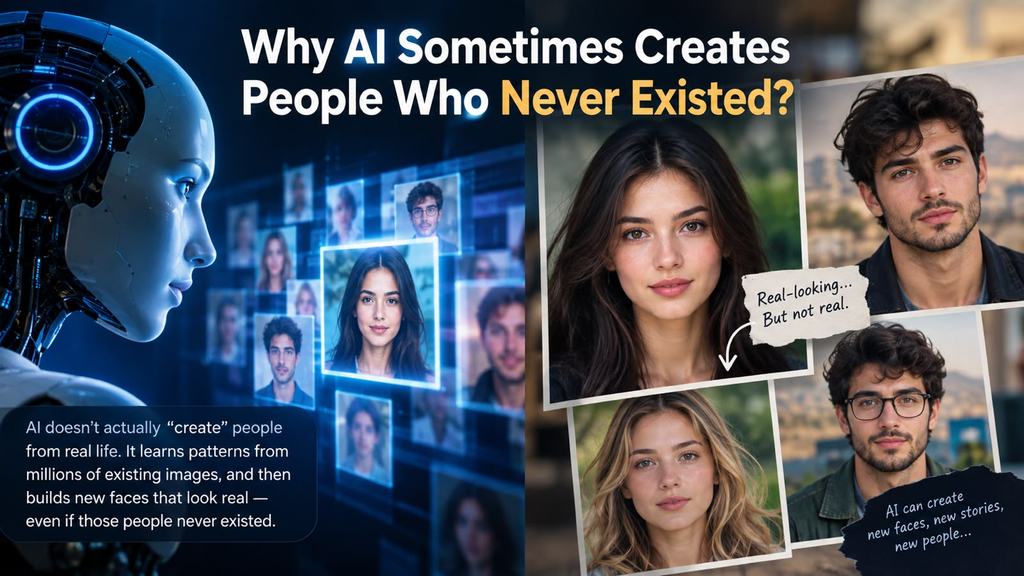
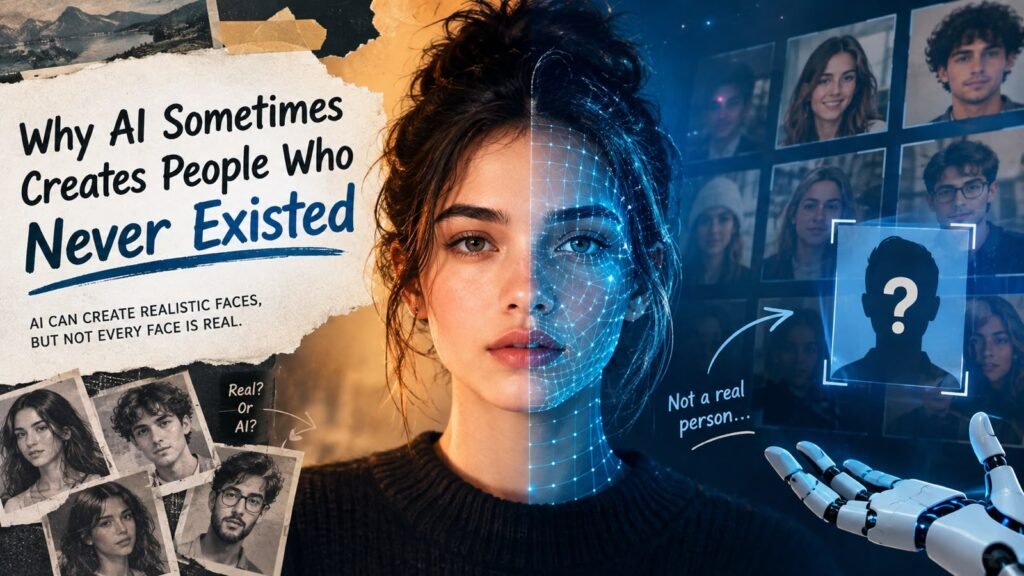
When you look at the pictures produced by any AI image generator you will see them: faces that appear real but do not belong to anyone. AI‑generated faces show pores AI‑generated faces have features and AI‑generated faces have expressions that feel natural. If you searched for AI‑generated faces in a crowd you would not find them. AI‑generated faces never existed.
This phenomenon is not a mistake in the sense. It is the expected result of how generative artificial intelligence systemsre built. To understand why AI creates people we must look under the surface of the technology at the statistical logic that drives image synthesis at the training data that shapes its outputs and at the economic reasons that make synthetic faces valuable.
The Core Mechanism: Statistical Aggregation, Not Memory
At its heart AI image generation does not. Copy photographs from a database. It creates images from statistical patterns learned during training.
When a diffusion model is trained on millions of photographs of faces it does not keep those faces. Instead it learns the probability distribution of how a face looks where eyes usually appear how skin textures differ what lighting is normal. The training process splits images into pixels. Assigns weights that show how likely certain pixel patterns are to appear together. The model is not “understanding” a nose or a jawline; it estimates the relationships between visual features.
When you ask the model to generate a face it begins with noise and slowly refines it following the statistical patterns it has learned. The result is a face that fits the learned distribution it looks like a face because it carries the properties of the training data but the AI‑generated face does not match any specific person in that data.
A useful historical example is Francis Galton’s composite photography, which layered many faces into one averaged image to identify “types.” Kate Crawford has pointed out that this method foreshadowed the logic of today’s machine learning systems: faces are created from datasets meant to categorize, compare and control. The synthetic face is, in a sense a composite a “mean image” that smooths individual differences into a representation of what a face is likely to be.
Why Hallucinations Happen: The Problem of Mode Interpolation
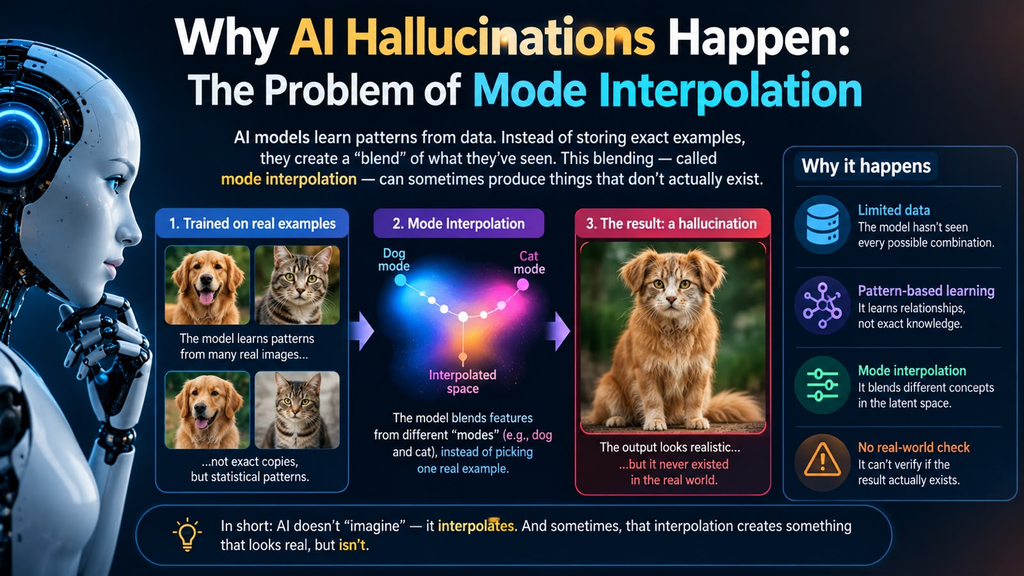
If AI repeated statistical averages synthetic faces would look plain and generic not the very realistic people we actually see. The strange unsettling results come from a phenomenon that researchers call mode interpolation.
A diffusion model’s training data forms a “support” set the range of images that’re plausible given the training distribution. An image outside that support is a hallucination. Mode interpolation happens when the model creates something that falls between two data points in a place where no real data exists.
Consider an example: a model trained on pictures of hands each hand having exactly five fingers. The model learns patterns for five‑fingered hands. When it creates new images it might combine different hand positions and accidentally produce a hand with six fingers. That six‑fingered hand is not in the training data. It is a plausible blend between two real configurations. The same idea works for faces: an AI might mix features from faces in ways that produce a consistent realistic‑looking person who never existed in the training set.
This is why AI‑generated people can look so convincing yet be entirely fictional. The model is not putting a face together from parts like a Frankenstein creature. It is moving through a statistical space and sometimes it ends up in areas that are plausible but have never been seen areas where a face exists that no human has ever had.
The Uncanny The Limits of Detection
The realism of AI‑generated faces has reached a level where human perception has trouble telling them apart from photographs. A recent study on perception found that when people were asked to tell faces from AI‑generated faces they did no better than random guessing. After training their performance improved only a little. For voices people confused AI‑generated voices with real ones 80 % of the time.
This matter is important because it shows that the “never existed” quality of AI‑generated faces is not obvious to the eye. The human brain, which is very good at spotting differences, in facial shapes is being tricked. The uncanny valley the unease we feel when something looks almost but not quite human is being crossed. Generative AI is creating AI‑generated faces that go beyond it.
The implications go beyond novelty. A study from the Harvard Kennedy School showed that people were more likely to trust false article headlines when they were paired with AI‑generated images. For example an AI‑generated image of the Louvre on fire with an authoritative headline was judged more credible than the same headline without any image. I have seen how synthetic people can give claims a false sense of credibility,
Read more :Why AI Chatbots Feel So Human And What That Means for Us
From Faces to Identities The Economic and Ethical Dimensions
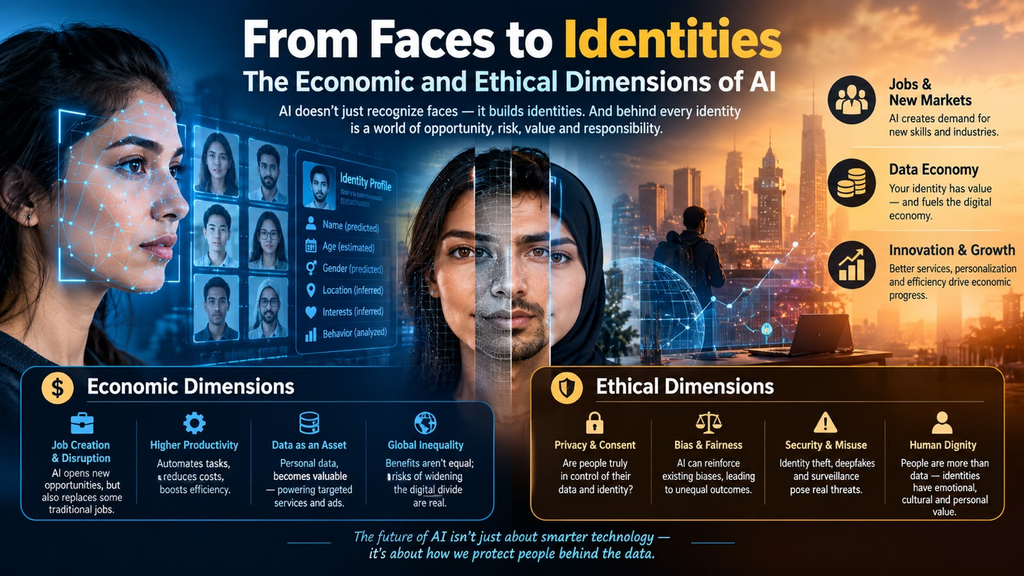
The creation of people is not just a technical curiosity. It is an activity that carries significant ethical stakes.
Companies use faces to sidestep privacy problems when building training datasets for facial‑recognition systems. Of using real people’s photographs which bring consent and compensation concerns they generate thousands of faces that belong to no one. This solves one problem but creates another: the synthetic faces are trained on faces, many of which are taken from the internet without consent.
The training data for these systems carries the logic of portraiture along with its historical biases. An analysis points out that synthetic portraits do not escape the structures of photographic portraiture; they produce “familiar, acceptable and repeatable versions of the human” shaped by unequal social dynamics in the training data. The synthetic face is not neutral. It reflects the patterns of the photographs used to train it and therefore it can reinforce existing biases and stereotypes.
The misuse potential is large. Hyper‑realistic AI image generators have been used to create evidence in court cases to produce non‑consensual intimate images of celebrities and to spread disinformation on a large scale. Google’s Nano Banana image generator for example has faced criticism for producing content while its watermark can be easily removed and its terms of service say it is not responsible for misuse. The technology moves faster than the safeguards.
Read more : Is AI Making Us Lazy?
The Deeper Implication Presence Without Encounter
Perhaps the profound aspect of AI‑generated people is what they reveal about how photography works.
A photograph of a face suggests that a person stood before the camera. The photograph is indexical – it points to a moment a real presence. Synthetic portraiture breaks that link. An academic analysis says that what disappears in faces is “the conditions for human‑to‑human encounter and human presence”. The face becomes a simulation of presence that lacks the encounter that has historically made photography meaningful.
This is not a philosophical idea. It has consequences. When we look at a face we are seeing a statistical mix of many faces, anonymized and averaged. The person we think we see is a blend of everyone and of no one. The eyes that look back at us never looked at anything. The unevenness that makes the face feel real is a trick.
Yet the face can be very convincing. This is the paradox of people: they are both real as images as data points as commercial products and unreal as individuals as subjects as presences. They exist in a limbo believable enough to deceive but with no one behind the eyes.
Conclusion
AI creates people who never existed because that is what it is built to do. The technology learns patterns from large collections of real faces and creates new combinations that follow those patterns without matching any single person. The process is not. Memorizing, but probabilistic synthesis.
Mode interpolation explains why synthetic people can look so convincing: the model moves through a space and sometimes lands in areas that are plausible but unexplored creating faces that could exist but do not. The result is faces that cross the valley and enter the realm of deceptively real.
This ability brings both promise and danger. Synthetic faces solve privacy problems for dataset creation. They also enable disinformation, fraud and the erosion of trust in visual evidence. The technology is not inherently malicious. It is inherently powerful and the safeguards have not kept pace with its capabilities.
Ultimately the synthetic face forces us to face a question that photography once seemed to answer: What does it mean to see a face? The photographic portrait suggested a person. The synthetic portrait suggested a pattern. In that gap between implication and reality lies both wonder and danger, in AI.
