


Introduction
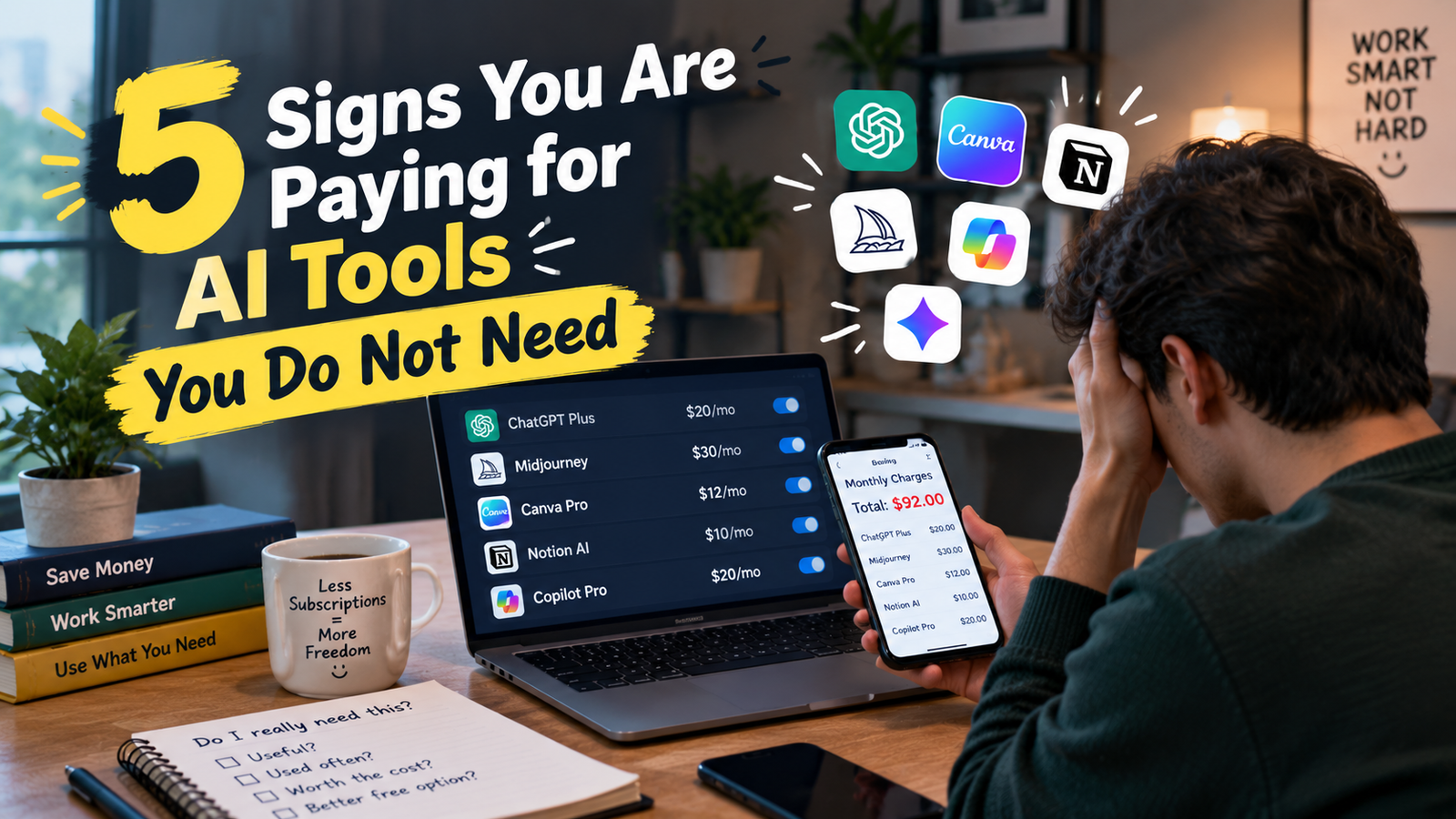
Lets be honest: artificial intelligence has become the new toy of the business world. Everywhere you look there’s an AI tool promising to revolutionize your workflow save you hours of work and basically make you a productivity superhero.. You know what? Many of them are genuinely fantastic.. Here’s the uncomfortable truth nobody wants to talk about a lot of us are paying for AI tools we simply don’t need.
I’ve been there myself. At one point I was juggling subscriptions to four different AI writing assistants, two image generators, a transcription service and something called an “AI-powered decision intelligence platform” that I still can’t fully explain. My monthly bill was creeping toward $200. I was using maybe 10% of what I was paying for.
If that sounds familiar you’re in company. A recent survey found that nearly half of businesses admit they’re overspending on software subscriptions and AI tools are quickly becoming the biggest culprit. The problem isn’t that AI is useless it’s that we’ve been conditioned to believe we need all of it all the time.
So how do you know if you’re throwing money at tools that are just collecting dust? Here are five telltale signs.
Sign #1: You Can’t Remember the Time You Logged In
This one seems obvious but you’d be surprised how often it happens. Subscription fatigue is real and AI tools are masters of the “set it and forget it” billing model.
Pull up your bank statement now. Look at every AI subscription you’re paying for. Now ask yourself honestly: when did I last open that tool? If you’re struggling to remember that’s a red flag.
I once paid for an AI meeting summarizer for eight months before realizing I hadn’t attended a meeting that required summarizing. The tool was great. My need for it? Nonexistent.
Quick check: Go through your 30 days of tool usage. If a subscription hasn’t been touched in that window it’s probably time to cancel. You can always resubscribe if a genuine need arises.
Sign #2: You’re Using a Premium Tool for Free-Tier Tasks
Heres a pattern I see constantly: someone signs up for an AI tool with a generous free tier uses it for basic tasks then upgrades to the paid plan “just in case” they need the advanced features. Spoiler alert they do.
Think about it. If all you’re doing is generating social media captions do you really need the enterprise plan with API access, unlimited word generation and priority support? Probably not. Many free tiers offer more, than enough for users.
| Task Type | Free Tier Usually Enough? | Paid Tier Worth It? |
|---|---|---|
| Basic text generation | Yes | Only if high volume |
| Image generation (occasional) | Yes | Only for commercial use |
| Transcription (under 30 min/month) | Yes | Only for heavy users |
| Advanced data analysis | Rarely | Usually yes |
| Team collaboration features | No | Yes, if working in teams |
The lesson here is simple: match the tool to the task not to your ambitions. That fancy AI writing platform with 47 features? You are probably using three of them.
Sign #3: You Bought Into the Hype, Not a Real Problem
Let us talk about FOMO fear of missing out. The AI industry is a master at creating it. Every week there is a game-changing” tool that is supposedly going to leave you in the dust if you do not sign up immediately.
But here is the thing: a tool is only valuable if it solves a problem you actually have. If you signed up for an AI coding assistant but you do not write code that is not an investment it is a donation to a startups funding round.
I call this “solution shopping.” Of identifying a problem and finding an AI tool to solve it I find a cool AI tool and then invent reasons I might need it. I am doing it backwards. It is expensive.
Ask yourself: What problem does this tool solve for me? If you cannot answer that in one sentence you have been sold on hype, not value.
Sign #4: You Are Double-Paying for Overlapping Features
This is the one. Many AI tools have quietly expanded their feature sets to the point where they overlap with tools you already pay for.
For example your AI writing assistant might now include image generation. Your project management tool might have added AI meeting notes. Your email client might have built-in AI drafting. If you are also paying separately for tools that do these exact things you are essentially paying twice for the same outcome.
I have seen businesses paying for:
An AI writer AND an AI email assistant (when one does both)
A transcription. A note-taking app with transcription built in
An image generator AND a design platform with AI image features
Action step: List every AI tool you pay for and write down its three features. If you see duplicates. Pick the one for each function and cancel the rest.
Sign #5: You Are Paying for “Someday” of “Today”
This might be the most human sign of all. We buy tools for the person we want to become, not the person we currently’re
You know the pattern. You sign up for an AI course platform because “someday” you will learn engineering. You subscribe to an AI analytics tool because “someday” your business will be big enough to need it. You keep that premium plan because “someday” you will use all those features.
Someday” has a way of never arriving and in the meantime your credit card keeps getting charged. Paying for potential is one of the common ways people waste money on AI tools.
The fix: Pay for what you need today. Most AI tools offer plans with no long-term commitment. When your needs change, upgrade then. You will save money. Avoid the guilt of unused subscriptions.
Read more:How AI Coding Assistants Changed Code Review
How to Audit Your AI Tool Spending

If you have recognized yourself in two or more of these signs it is time for an audit. Here is a simple process:
List everything
Write down every AI subscription and its monthly cost.
Check usage
Look at your login history for the past 30–60 days.
Identify the problem each tool solves
If there is no problem it is a candidate for cancellation.
Look for overlaps
Consolidate where possible.
Cancel
Start with the tier if you are unsure and cancel anything unused.
Set a reminder
Revisit your subscriptions in 90 days to make sure you are still getting value.
You might be surprised how much you save. One person I know cut $140 per month by canceling four AI tools she was not using that’s nearly $1,700 per year back in her pocket.
Conclusion:
AI tools are incredible. They can genuinely transform how you work, create and solve problems.. Like any tool they only deliver value when they are actually used for something that matters.
The five signs we covered forgotten logins, premium plans for tasks, hype-driven purchases overlapping features and paying for “someday”are all symptoms of the same underlying issue: buying AI out of fear or habit rather, than genuine need.
The good news? Fixing this is straightforward. Audit subscriptions, be honest, about usage. Have the courage to cancel subscriptions that aren’t serving you. Wallet will thank you. Oddly you will probably get more value from the few AI tools you actually use. Remember: goal isn’t to use every AI tool there. Goal is to use the AI tools for you. Everything else is expensive noise.
